The constant sounds of falling water and rustling winds make up much of the landscape of the Gorge.

Dog Creek Falls, Washington
The constant sounds of falling water and rustling winds make up much of the landscape of the Gorge.
Dog Creek Falls, Washington
Across many North American indigenous cultures, the thunderbird carries many of the same characteristics. It is described as a large bird, capable of creating storms and thundering while it flies. Clouds are pulled together by its wingbeats, the sound of thunder made by its wings clapping, sheet lightning the light flashing from its eyes when it blinks, and individual lightning bolts made by the glowing snakes that it carries around with it. In masks, it is depicted as multi-colored, with two curling horns, and, often, teeth within its beak.
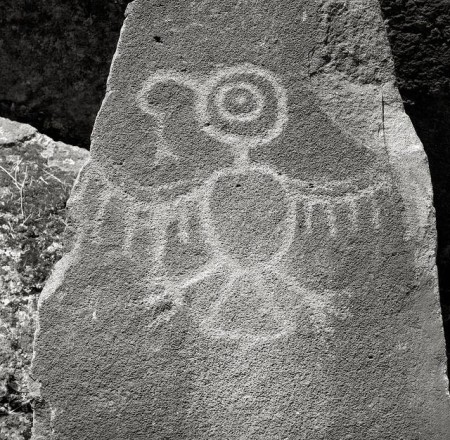
This Thunderbird petroglyph rests at Horsetheif Lake in the east end of the Columbia River Gorge, in Washington.
The salt of time has worn the edges a little thin as the image wains in it’s slow compost. The timeless ghost of the unidentified figure suspended in haunted air. This bridge between the past and now, triggers my own memories, sneaking across forbidden entries, to break to the other side, and bathe in the glory of the Springs. The constant murmur of white waters washing across old stones and the sulphured air, and many generations baptized. I have come to believe that this is where the Gods live.
Two swinging bridges across Wind River. An unidentified person stands on one bridge. Written on the back of photo- “Swinging bridge Shipherd’s Hot Springs.”
“No one must look at the rocks of the bridge. People knew that some day it would fall. They must not anger the Spirit Chief by looking at it, their wise men told them.
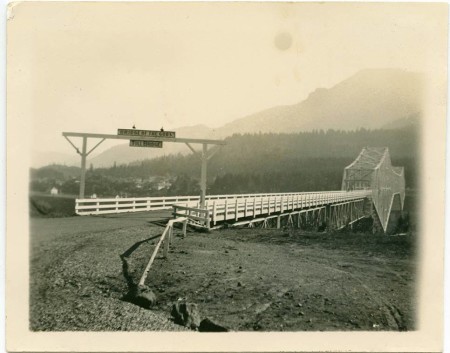
‘Bridge of the Gods’ ca. 1929, photographer unknown.
Read more here
The smells mingled in a frenzy of excitement, swaying with the brisk winds, carrying laughter and conversations into the chilly August night.

1954 Skamania County Fair: unknown photographer.
This photo really sums up in an image what this project is about to me. I can imagine what it would feel like to be Great Grandmother, watching the old ways die underneath the feet of something new. The very landscape has been rearranged and so has our Story. This photo is of the Cascades and Cascade Locks, Oregon prior to bonneville dams construction in the early 30′s.

A photo taken just before the Cascades were silenced. 193?, photo author unknown.
Read more about Bonneville Dam’s impact on my ancestors here
Celilo – Wyam 2005 Salmon Feast
Loss of Wyam caused pervasive sadness, even in celebratory events. The old Longhouse is gone. The Wyam, or Celilo Falls, are gone. Still courage, wisdom, strength and belief bring us together each season to speak to all directions the ancient words. There is no physical Celilo, but we have our mothers, fathers, sisters, brothers, and our children bound together for all possible life in the future. We are salmon (Waykanash). We are deer (Winat). We are roots (Xnit). We are berries (Tmanit). We are water (Chuush). We are the animation of the Creator’s wisdom in Worship song (Waashat Walptaikash).
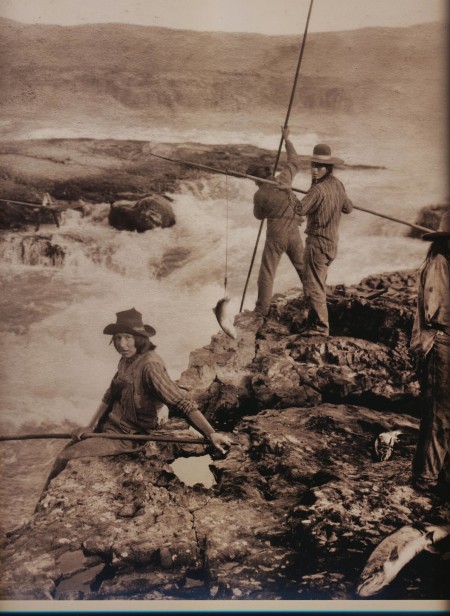
Unknown fishermen, unknown year, unknown photographer.. any information would be appreciated.
The leader speaks in the ancient language’s manner. He speaks to all in Ichiskiin. He says, “We are following our ancestors. We respect the same Creator and the same religion, each in turn of their generation, and conduct the same service and dance to honor our relatives, the roots, and the salmon. The Creator at the beginning of time gave us instruction and the wisdom to live the best life. The Creator made man and woman with independent minds. We must choose to live by the law, as all the others, salmon, trees, water, air, all live by it. We must use all the power of our minds and hearts to bring the salmon back. Our earth needs our commitment. That is our teachings. We are each powerful and necessary.”
published in River of Memory: The Everlasting Columbia,Layman,WilliamD.,Ed. UP: WA. Seattle, WA 2006
“…. They didn’t sign away their rainy Eden or sell it, die in warfare, or move to reservations, not until twenty-five years after the catastrophes that swept most of them away. It wasn’t smallpox that laid them low. Suddenly most of them were simply gone. The Wapato Lowlands in particular were empty and silent. Did
 God call them home? The few survivors walked away dazed. Took to speaking other languages. Were replaced by strangers. After a few decades hardly anyone remembered that they had ever been there.”
Read more of “She Who Watches — Tsagaglalal By Rick Rubin” here: http://www.ochcom.org/chinook/
Listen to the story, ‘She Who Watches — Tsagaglalal’, as told by Ed Edmo:
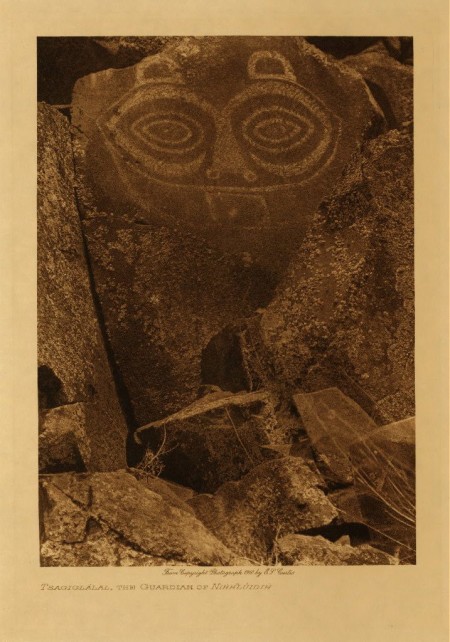
An Edward S. Curtis photo from 1909 of my Ancestors old village site near Skamania, Washington. Lewis and Clark called us the ‘Shahala Nation’, when they came
 through the Gorge in 1805. We lived in three subdivisions: the Yhehuhs, who were above The Cascades of the Columbia River, the Chahclellahs, who lived below The Cascades, and the Wahclellahs, who lived near Beacon Rock. We had six villages on both sides of the river until the 1830′s, when what was called the ‘Cole Sic and Warm Sic’ (Malaria) epidemic came through and decimated our numbers to near extinction. Some number perspectives: in 1780, we numbered 3,200, in 1805, Lewis & Clark’s count was 2,800, 1,400 in 1812, and about roughly 80-100 after the epidemic of the 1830′s. The survivors then created the single village that became the Wat-la-la.
Sasquatch runs deep through my family. My Grandmother use to tell me stories that would make my hair stand on end.
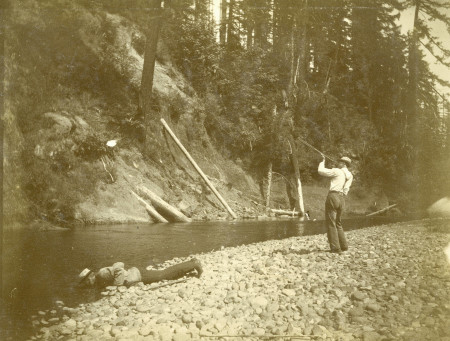
Hunting on Rock Creek near Stevenson, WA. c. 1911
You can hear my Uncle’s story about ‘the call of Sasquatch’ here: