Up until the completion of Bonneville Dam in 1938, a ghostly white forest of drowned tree stumps could be observed along both sides of the Columbia River between Cascade Locks and The Dalles. The submerged forest was first mentioned in a geologic textbook in 1853, in “Principles of Geology” by Sir Charles Lyell
“Thus Captains Clark and Lewis found, about the year 1807 (sic), a forest of pines standing erect under water in the body of the Columbia RIver, which they supposed, from the appearance of the trees, to have been submerged only about twenty years.”
Both Lewis and Clark in 1805 and Captain Fremont in 1845 recognized that the trees were drowned by the formation of a lake behind a 200-foot landslide dam.
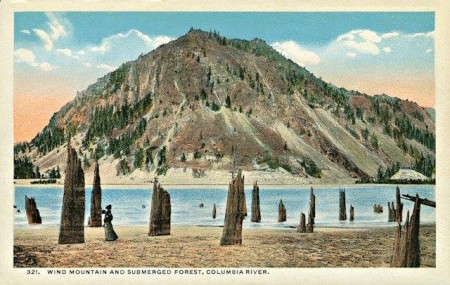
Penny Postcard, ca.1920s, “Wind Mountain and Submerged Forest, Columbia River”.
Source: John Allen, Professor of Geology at Portland State University, 1985, “Time Travel in Oregon”.
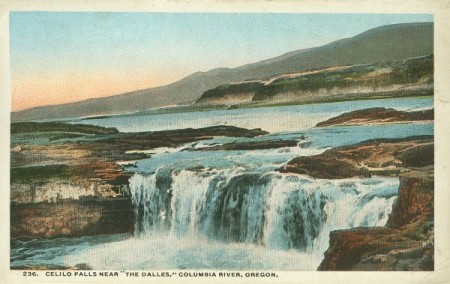
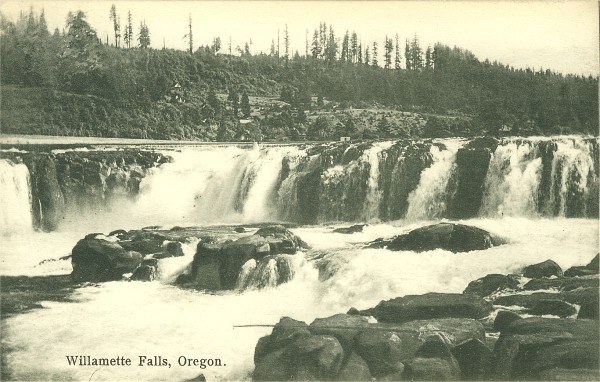 All the Indians came and began to fish. Now Coyote made his magic fish trap. He made it so it would speak, and say Noseepsk! when it was full. Because he was pretty hungry, Coyote decided to try it first himself. He set the trap by the Falls, and then ran back up the shore to prepare to make a cooking fire. But he had only begun when the trap called out, “Noseepsk!”