The Four Lettered Word

{Tell me about a breakfast you were once privileged to have, Eggs over easy? Grapefruit? One thin slice of toast? Not even that. You ate a pickle- an it never tasted so good. You vowed to eat pickles for breakfast for the rest of your life. Then what happened? Tell me. Be Specific. Go. Ten Minutes. }

Red mingled neon lined diner seats holding conversations and memories tucked beneath tables set with old silverware shaped in compass formations and pointed in the four directions. Hunched low, eyes diverted to the sun setting just beyond the shadow of the stained half pulled blinds.

It was on odd time for breakfast, but timing was never my strong suit, or any suit for that matter. The coffee dressed in brown, and creamers that cause cancer stacked in messy pyramids. (Sometimes I missed the smell of cigarettes with a side of bacon)

It made the perfect setting, for the perfect breakfast. Because, in the words of Thomas-Builds-A-Fire, “Some days is a good day to die, and some days is a good day to eat breakfast.” And given this my first meal outside of the ward, I was lucky to be alive.

“Where you from, hun?”- the waitress asked with a forced drawl, the kind you heard in the bonanza reruns grandpa watched when we were kids.

“Well,” I hesitate, trying on words in my mind, seeing how they fit. “I guess, I never really felt like I was from anywhere, if I must be honest.”

“That would be nice, now wouldn’t darling,” she says, “Nobody up in yer business all the time, no embarrassment from being picked on as kids, or yer kids embarrassing you.”

She stops, and with her, time stood still, hot pot of coffee in stasis, the sound of smacking gum between red lips reverberating through space. She gives me and my bright orange jumpsuit a look over, soft and southern eyes drinking me all in.

“Well damn, hun. You do look well traveled and in need of, oh, I don’t know, some greasy kind of healing” she snaps, her fingernails like knives unsheathed.

“Today was a good day” I proclaimed, grinning with a pharmaceutical smile, “Didn’t have to use my AK.”

“That’s nice, Hun.” She grabs my menu, gives me a wink, and disappears into the greasy purgatory of the setting sun. The sound of time unwinds, the clank of glass, and the choir of line-cooks, standing in for the angels.

“Today was a good day..”

James Baldwin and the art of Listening

“Perhaps home is not a place but simply an irrevocable condition.”

― James Baldwin, Giovanni’s Room

” Listen also to what is not said. It is a listening not just with your ears- though ears are a fine thing- but listening with your whole body, with your heart and the hairs on your arms and the small toes of your feet. Try doing it this way, when you read James Baldwin, one of our great American writers, out loud: “ (Old Friend from Far Away, pg. 27)

“On the 29th of July 1943, my father died…
(reading from Notes of a Native Son James Baldwin Full Audiobook mixed with old radio recordings from 1943 and other found sounds. mixed by Si Matta)

Listening to the sound of words in my brain tossing with the gusts of wind blowing south through the San Luis Valley, hitting the house in waves like a chorus for the sonnets rattling in my bones.

{Here alone, listening to what is not said in the daily search for clarity, divinity, or, just a padded cell far away from the prying eyes of gossip and social reproach.}

No matter the criteria for a forced hermitage, the silence can be deafening, a meditation to madness, and/or the peace that always seemed so elusive and out of reach-, like soft dust in the mesa wind, fleeting like fathers, and like Baldwin I understand that father wound. Fueling pen and therapy bills.

“I often wonder what I’d do if there weren’t any books in the world.”

— James Baldwin

A good book can grip you like that, old memories, kitchen sink, shadowboxing someone else’s story. A good book is a hustle, and a grift with reality, a dance with the matrix programmed by others vulnerabilities and tastes. Like a home, a good book can trap you.

{I listened with my organs,
straining through black
tar tobacco smoke
and words
shoved
down
throats,
spoken
in rooms
that didn’t
deserve
me.

“Don’t you know me dad,
I’m your native son”}

Green Stuff: What Legends are made of

Jello made its way into my family’s DNA—one molded and folded, whipped and loaded potluck after another, it became a part of our family tree. Growing up, the space-aged gelatin treat was present at every gathering and on every road trip. In the mountains, around the fire, we’d pass around Tupperware filled with finger jello, sometimes encasing unsuspecting maraschino cherries in its gelatinous embrace. Or we’d enjoy raspberries whipped with Cool Whip, baptized in cottage cheese-textured bliss. But my mother’s Green Stuff was the stuff of legends—a true crown jewel among the Potluck Queens.

It was a mystery, a secret recipe passed down from Sunset magazines and the backs of cleaner boxes.

“Jules, what’s in that?” people would ask. “It’s a secret,” she’d reply.

It tasted of pistachios and cottage cheese, walnuts and grapes. Heaping green mounds adorned our cousins’ plates, alongside Grandma’s chicken and the promise of safety.

Eulogy for all the ways we say wind

“The wind shows us how close to the edge we are.” ~Joan Didion

IMG_7330The dashboard glowed faint and useless, the numbers flickering with a tired rhythm that offered no comfort. The gas gauge hovered above empty, the check engine light a steady, accusatory orange. I stared at the dash, willing it to tell me something, anything. But it only pulsed with the stubborn life of a machine too old to trust. I cut the engine. The silence that followed felt heavy and broken, pressing against the thin, dinted glass of the windshield.
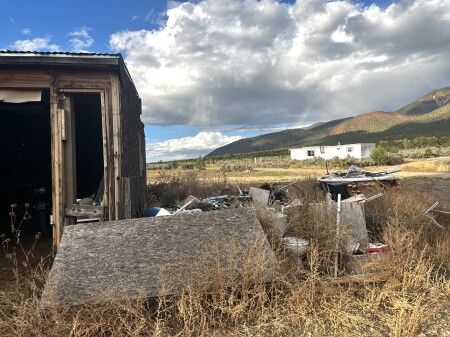
The mesa unfolded in front of me, open and exposed, stretching endlessly under a bruised sky. The sun was already swallowed by the horizon, leaving only a thin line of fire on the edge of the world, burning away the last warmth of the day. A chill crept in, sharp and insistent, curling beneath my jacket and into my bones. The desert air tasted of dust and old dreams.

I sat still, knuckles pale against the steering wheel, watching as shadows drifted along the roadside. Out here, the distance wasn’t just space. It was a presence, looming and impossibly broad, a kind of emptiness I couldn’t drive through or leave behind. It was the kind of quiet that made you think of everything you’d ever lost.

A River runs through me.

A River runs through me.

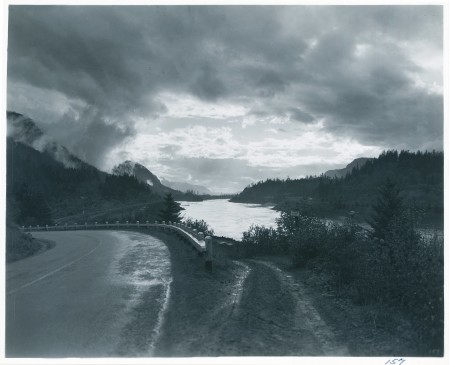
I thought of the Gorge, miles and memories away. I thought of rain pounding down in thick sheets, of the river below roaring with purpose, carving its way through stone. There, everything felt alive, if only for a moment; water and wind and the scent of fir. But here, only dust floated, refusing to settle, shifting with every restless breath of wind. The sky seemed wider, the world more brittle.

Was anything left back home? Did the fog still roll in off the water, thick and forgiving? Or had even that faded, leaving behind only dry riverbeds and brittle grass? I tasted nostalgia like iron on my tongue—sharp, metallic, unyielding. Memory flickered, unreliable and distant. I tried to recall faces, voices, the weight of belonging, but the details slipped away, replaced by the drone of cicadas and the endless sigh of the wind.

Had I ever really belonged anywhere? Or was it only the illusion of belonging I missed? Or the comfort of a place that remembered me, even as I tried to forget it?

I opened the door, letting the cold rush in. The air outside was thin and empty, charged with a restlessness I couldn’t name. I stepped out, boots crunching on scattered gravel. My shadow stretched long and distorted, a thin echo on the faded earth. The land was silent except for the wind, which carried the faint smell of sage and something burnt.

I wandered a few steps from the car, eyes searching for some sign: a familiar rock, a twisted juniper, anything that would anchor me. But every landmark felt strange, hollowed out, as if the world itself had shifted in my absence. The land offered no comfort, only space and silence and the slow, creeping dread that whatever I was searching for was already gone.

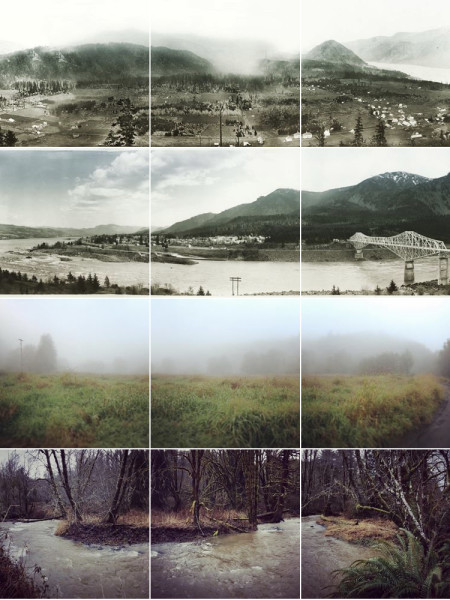
Sunset on Columbia River from Bridge of the Gods. 193?

Sunset on Columbia River from Bridge of the Gods. 193?

Sometimes, in dreams, I saw the Gorge as it used to be; wet, green, alive. I saw my mother’s hands, my father’s boots by the door, the soft glow of lamplight on fogged windows. But here, the past felt unreachable, a different lifetime entirely.

Time felt heavier here, pressing down, flattening hope, flattening memory. I kept scanning the horizon, looking for signs. Anything that would tell me which direction was forward, which was back. But the desert gave nothing away. The world was pared down to essentials: rock, sky, wind, and the slow ache of longing.

I found myself thinking about the people I’d left behind. Friends I’d promised to write. A sister who never answered the phone. The neighbor with the old dog who always barked at dawn. Had they changed, too? Did they remember me, or was I just another name lost in a stack of mail, a number in an address book never dialed?

IMG_8943The stark beauty of the mesa cut deep. It was a beauty I couldn’t carry with me, only endure. I stood by the old 4Runner, staring west, wondering if the Gorge remembered me. Wondering if the dust there was still dark, still alive, or if it had turned to ash, scattered and lost by time and wind.
The wind shifted, colder now, bringing only the scent of stone and emptiness. I slipped back inside, shivering, my hands trembling against the cracked vinyl seat. The darkness outside pressed closer, hungry and vast, and the world I once knew felt impossibly distant, receding in the rearview.

Circling in dreams.

Pulling Grief from the Sky

“You were really beautiful, thank you”- Nick Cave

The road unwound like
a long-held breath,
its rhythm soft as
the heartbeat of stone.

She leaves the earth of
Mesas behind, red dust
curling in the rearview,
the bones of
old places.

The sky is wide enough
for her grief tonight,
stretching taut,
bruised with stars,
a canvas for memories
she cannot bury.

She drives east, a hymn
to the unbroken road.
Her body a map,
etched in ink, scar,
and story, a nurse’s hands,
a wanderer’s soul.

But grief does not shake;
it settles, heavy
as a stone,
silent as the wind.

The sky stretches endless,
its wounds glowing
faint in the
morning light.

She breathes it in,
the ache, the wonder,
the endless gathering
of what is lost
and what remains.

She wonders if she
could reach up,
pluck her sorrow
from the heavens
and hold it like
a wildflower,
its petals torn
but still fragrant,
resting on graves.

to something,
she can’t
yet
name.

© Si Matta

Dreams We Weave, Marks We Leave: Reflections on Poet Warrior by Joy Harjo

“I walk in and out of several worlds every day.” —Joy Harjo

Link: Poet Warrior: A Memoir, By Joy Harjo

Some mornings, I wake unsure which world I’ve landed in. My body is here, jittered, somewhat grounded, pressed to the cold skin of earth, the taste of coffee lingering at the back of my mouth. But my mind is scattered across dream and daylight: one part drifting through old stories, the other scrolling the infinite blue of my phone, looking for a sign that I still belong to something older than algorithms.

Dreams have always been more than private flickers behind closed eyes. Among my people, dreams are the braids that bind us—to land, to each other, to those who came before and those not yet born. Dreaming isn’t solitary; it’s a communal current, threading through ceremonies, firesides, and quiet dawns. The dreamers are weavers.They return with gifts: stories, warnings, laughter, medicine for the waking world.

Joy Harjo calls these dreamers “poet warriors.” I read her words in Poet Warrior and feel the braid tighten around me, a gentle, insistent pull. She writes, “We are evidence of love, the burdens and gifts we carry,” and I sense the weight and the lift of that inheritance. She reminds me that story itself is a braid, never a single strand, but three, four, a dozen voices woven together. The dreamer listens not just to their own heart, but to the wind rattling the cottonwoods, to the ancestors whispering through the river, to the coyote slipping through the dawn.

I often reflect on what it means to be part of a story that is bigger than just myself. Poet Warrior isn’t a book that moves in a straight line. Instead, it circles and returns, built from fragments and spirals. Harjo’s chapters loop back on themselves, weaving together poems, memories, songs, prayers, and prose. Each layer adds meaning, like a river building up silt or a petroglyph deepening with time. Reading her work gives me permission to let my own writing roam, to braid together poetry and memory, image and reflection, to trust that the story will hold together, even when I can’t see its full shape.
#

I can’t do anything
but talk to the wind,
to the moon
but cry out goddamn goddamn
to stones
and to other deathless voices
that I hope will carry
us all through.” ― Joy Harjo

The first time I pressed my hand to a petroglyph on the basalt cliffs above the Columbia, I didn’t know what I was supposed to feel. The stone was warm, almost oscillating. The spiral carved there was older than any story I’d heard in English, older than the language I never learned but sometimes dream in. It felt like a conversation I’d arrived late to, but could still lean in close and catch a word or two. Stepping into a circle already formed, voices looping through the centuries, I pressed my ear to the stone, caught a word, snagged a thread, and let myself be woven in. Even if I had missed the beginning, somehow, I belonged.

“Remember, you are this universe and this universe is you.”

I think about craft, what it means to make a mark meant for someone you may never meet. The old petroglyphs were not just art, but message: I was here. We hunted here. Water came from this place. The salmon ran strong. Maybe a prayer layered in, or a bit of trickster mischief. The tools were simple. The intention was not. Harjo teaches that poetry, much like petroglyphs,is a way of listening as much as speaking. She writes, “I follow the spiral to the core, to the source, to where dreaming and the story begin.” My own tools now are a cracked phone, a battered notebook, a keyboard sticky with coffee rings. My marks are digital, ephemeral, a tweet, a story pinned to a map, a GPS breadcrumb trail a cousin left to show where the old berry patches still grow. But the intention remains: to reach someone beyond my sight, to leave a trace that says,

This is what mattered to me. This is what I saw.

#

I sit up in the dark drenched in longing. / I am carrying over a thousand names for blue that I didn’t have at dusk.”― Joy Harjo

When I read Poet Warrior, I recognize the mark-making urge in myself. The need to leave something, not just for remembrance, but for renewal. Harjo reminds me that every mark was new once, every story is a risk, every dreamer in danger of being erased or misunderstood. The work is not to guarantee permanence, but to show up with intention: to carve, in whatever medium, a story that’s honest, open, and willing to be found. “The story is always ahead of you, waiting to be found,” Harjo writes. Her words invite me to experiment with form: to let prose and poetry flow together, to create layers a future reader might sift through like sediment, discovering pieces of what was meant.

The best marks, I think, are collaborative, layered with meaning the maker never imagined. In Harjo’s words, “We all become ancestors in training.” What we leave behind is not only for remembrance, but for renewal.

Jaundiced Light

“Some folks call her a runaway. A failure in the race. But she knows where her ticket takes her. She will find her place in the sun”
― Tracy Chapman

Wilma stands beneath the sour glow of the Dollar General, the jaundiced sign humming over sage and river stones. Inside, the aisles are bright with plastic—candy-bright, memory-light—replacing the smell of bread that once crept from shuttered doors just down the road.

She rings up locals—faces creased by wind, pockets heavy with worry—stories trading hands like loose coins: a missing dog, a sun-festival in a canyon, a brother lost to the blues. Wilma gathers them in, her touch gentle as rain on dust.

At closing, she slips outside into the blue hush, mountains looming—watchful, bruised. She lights her menthol, exhales halos and steps under the holy light of neon, flickering behind her as coyotes call just beyond the shadows. Wilma walks home, steps soft as moth wings, carrying the day’s small losses, still searching for wild iris, just this side of dreams.

IMG_2210

Breakfast In America

“Vivir de recuerdos es morir.”
— Frida Kahlo

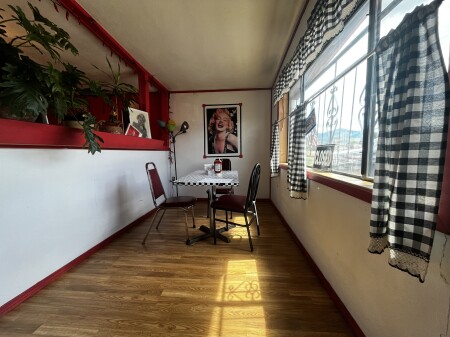
Rosaleen unlocked the door at eleven, the screen creaking open as pale dust danced in the shaft of morning light. The diner was quiet, its checkerboard curtains catching the sun, red trim glowing against the hush that filled the space.

In the kitchen, Tia was already at work, hair tied back, moving with a calm efficiency through the rising scent of chile warming in the pan. She hummed something old, her tune for no one but herself, as steady as the rhythm of her hands.

Out front, Rosaleen wiped down the Formica counters, set the forks straight, and checked the register. The visitor log lay open, names drifting across the page in blue ink—Wyoming, Berlin, Austin, even a doodle of a mountain. Locals knew to come after noon, their boots heavy, their stories heavier. Tourists arrived earlier, the screen door snapping shut behind them as they glanced at the Marilyn Monroe prints, the pie safe, and the handwritten sign:

“Breakfast All Day / Open 11-5.”

Coffee was poured, pie was served. Rosaleen’s voice was gentle, with just a trace of her grandmother’s Spanish in it—her cariño, soft as a secret, slipping into the morning air.

In the far corner, the jukebox played a song just out of reach, something slow, a melody that tasted of Patsy Cline and sunlight warming old tile. Tia called out orders in a timid voice that brooked no argument, red chile glistening as she wrapped burritos tight in Christmas colors. Rosaleen’s laughter mingled with her aunt’s in the steam and clang of pans.

The hours slipped by, measured in coffee refills, the sighing hush of the screen door, and the ever-growing list of names in the visitor registry—a traveler from Maine lost on the backroads, someone from El Paso, someone else just passing through.

At five, Rosaleen turned the sign, rinsed the last mug, and listened as the jukebox winds down its last dance- “I go out walking, looking for you”- She stood by the screen door with sunset falling across the empty booths, thinking of all the names left behind—lost, just on the other side of dreams.

Tia's Monroe

Road from the Sun

“If I could only fly”- Blaze Foley

I gave an old hippy named Willy a ride- he told me about heartbreak and being a hermit- told me I was on my way and let me know there is nothing to worry about.

He writes songs and said he just came from a festival they named after the sun- it was nestled in a canyon near Red River, I assume the festival is for the appreciation of light.

He hits my vape and tells me about the time he flew, car decided to try out for being an angel- forgot to get permission waivers from Willy.

He laughs and shows me old scars, coughs, tells me the weed these days is too strong.

He gets out, trailer 23, just this side of dreams.

IMG_3330

Glitch in the stream


“Call your spirit back. It may be caught in corners and creases of shame, judgment, and human abuse.
You must call in a way that your spirit will want to return.” – Joy Harjo

Introduction

Sometimes I think of this blog as a basket. A basket I’m always filling with fragments of myself. Land and water have their own ways of holding onto what matters, even as everything else shifts and slips away. Longing and belonging run through these pages; old stories keep surfacing, no matter how often we’re told to let them go or leave them behind.

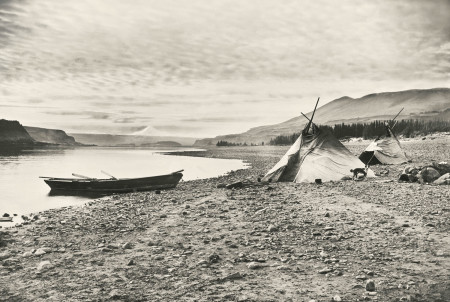
Home Guard on the Columbia, by Benjamin A Gifford (1899) (photo- courtesy The Valley Library, Oregon State University)

Home Guard on the Columbia, by Benjamin A Gifford (1899) (photo- courtesy The Valley Library, Oregon State University)

I keep circling back to those in-betweens: between faith and doubt, between what we’re allowed to say and what we still need to hear. Being two spirit, being queer, being Indigenous, none of it fits neatly into the categories handed down by those pamphlets and sermons. The stories I share here are often untidy, sometimes awkward, sometimes just a breath or a question.

Writing all this has been my way of making sense of what’s been lost and what still survives. Of finding the places where grief and hope sit side by side. Some days, the words come easy, like Coyote slipping through the brush; other days, it’s just sitting with the ache, waiting for something true to rise up.

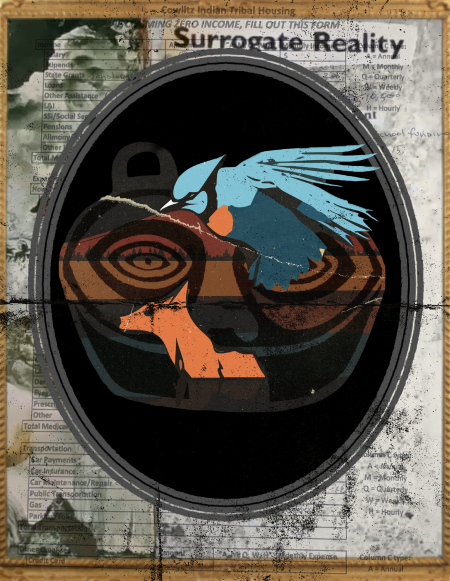
Art by Si Matta

Art by Si Matta

If you find yourself anywhere in this tangle—wondering, remembering, searching for language that feels like home—just know you’re not alone. There’s room here for all of it: the old stories, the quiet resistance, the new ways we find to belong to ourselves and each other. This is just another piece of the gathering. Let’s see where it leads.


I.Where the Story Glitched

As the onslaught of settlers to the Columbia River Basin dredged a new paradigm of disease and displacement, there was what Hunn describes as a “spiritual apocalypse” among the River People. (Hunn & Selam, 1990, p. 241) A “spiritual apocalypse” where animist cultures struggled with the biological reality of disease, for there had to be a spiritual reason for the trauma- something must be out of alignment with the spirit.

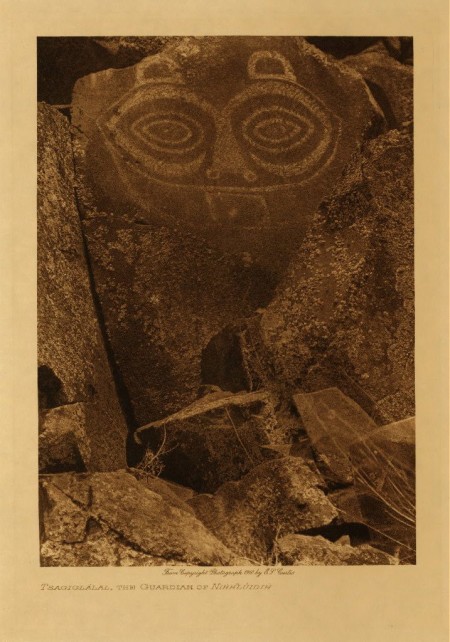
There are stories older than the fractures we inherit. Before the missionaries, before the epidemics, before the thunder of Coyote’s mischief echoed up the river, there was a different kind of order—one in which Tsagaglalal kept her eyes on the people, and the world was alive with spirit. But when Coyote turned her to stone and declared an end to women’s leadership, something was set in motion. Later, when settlers swept through, bringing disease and displacement, the River People faced not just a physical apocalypse, but a spiritual one. My ancestors, like so many others, searched for meaning in the devastation, believing something must be out of alignment with the spirit. I feel that search still, running like an undercurrent beneath my own questions of belonging, faith, and truth. The fracture didn’t end with them. It runs through me, too, and through the stories I’m still learning how to tell.
12697363_1109859742359005_2764864803838113474_oIn my family, and in the memories that float up around shared meals or linger in the quiet after a prayer, I sense the echoes of this original break. There’s a hunger to explain why so much was lost, why the world my great-grandparents described feels so different from the one I grew up in. The old stories say that when Coyote came upriver, laughing and clever, he brought change that was meant to keep order, but instead left us with a wound that never quite healed. Tsagaglalal—She Who Watches—was given a stone body so she could see forever, but her voice became something we had to listen for in the wind, or in the pause before an elder speaks.
When settlers arrived, carrying new gods and new diseases, the ground shifted again. The River People, rooted in animist ways,where stones, salmon, and even the wind carried spirit, were suddenly forced to face loss on a scale that felt impossible. Hunn called it a “spiritual apocalypse,” a time when the breach between body and spirit became impossible to ignore. When whole villages disappeared overnight, when familiar ceremonies failed to keep death away, my ancestors,like so many others at the time, searched for answers in the only places they could: in dreams, in stories, in the uneasy sense that something was out of balance in the world.
IMG_2610
It’s strange how trauma moves through generations. The original fracture—the turning of a matriarch to stone, the erasure of women and two spirit people from ceremony, was just the first. Every wave of missionaries, every epidemic, every law forbidding ceremony or language widened that split, until the silence itself felt inherited. I grew up catching glimpses of what was missing: a grandmother’s hesitation before telling an old story, a tightening around the word “queer,” the careful folding of hands before a meal, as if trying to keep the sacred from spilling out.

I wonder sometimes if this is why shame comes so easily—why depression feels built into the

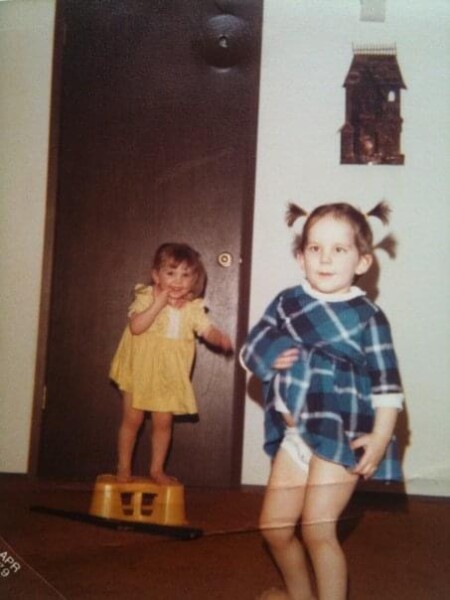
My Sister and I, circa 1979

My Sister and I, circa 1979

bones, why addiction and silence become so familiar. Colonial violence didn’t just take land or language; it planted silence deep in our blood, teaching our ancestors to guard their words, to tuck away what was sacred or strange for fear of punishment or loss. When you’re told that spirit and body are separate, that who you are or who you love is out of alignment with what the world expects, the original wound gets handed down- wrapped in shame, caution and grief. That kind of silence settles in quietly, showing up in the hesitation before a question, in the way stories are stopped short, in the careful ways we move through spaces that never felt safe for all of who we are. It’s a fracture that isn’t just history. It’s lived and relived every day, quietly shaping how we see ourselves and what we’re allowed to speak aloud. In this haze, the birds whispered my name.

II. The Birds Whispered My Name

Some birds are not meant to be caged, that’s all.- Stephen King

The birds whispered my name,
As I fidgeted on a cold chair,
Learning of a god dressed in thorns.

As they talked in righteous dictation,
I would pull thorny brambles from dirty hands-
Finding god in the splinters.

I remember how the rain tasted-
Dry in safe beds made from synthetic fibers.

Yet I could hear the birds whisper my name,
Telling me stories,

We forgot to tell ourselves.

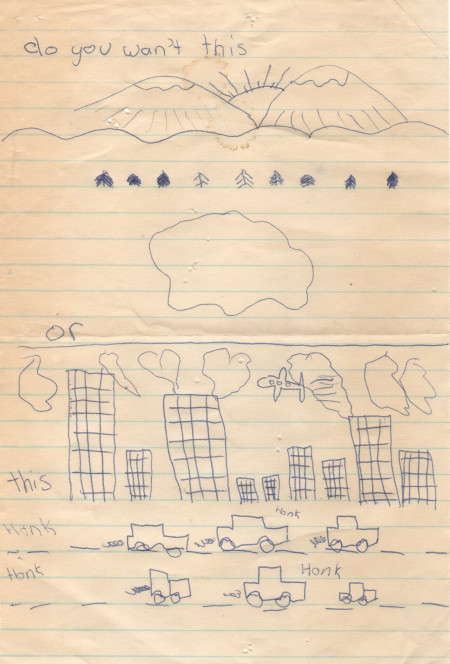
A very early drawing of mine I drew during church

A very early drawing my sister, Jadie Russell, drew in church. 1980′s