Grass Man: David Douglas meets my Cousins as told by Jim Atwell

David Douglas was sturdy Scotsman and a remarkable person. Before he was out of his 20′s, he had traveled from his native land to the wilderness of the David_Douglass00Pacific Northwest, where he made the botanical explorations that were to make him famous. It was he who gave his name to the Douglas Fir Tree.
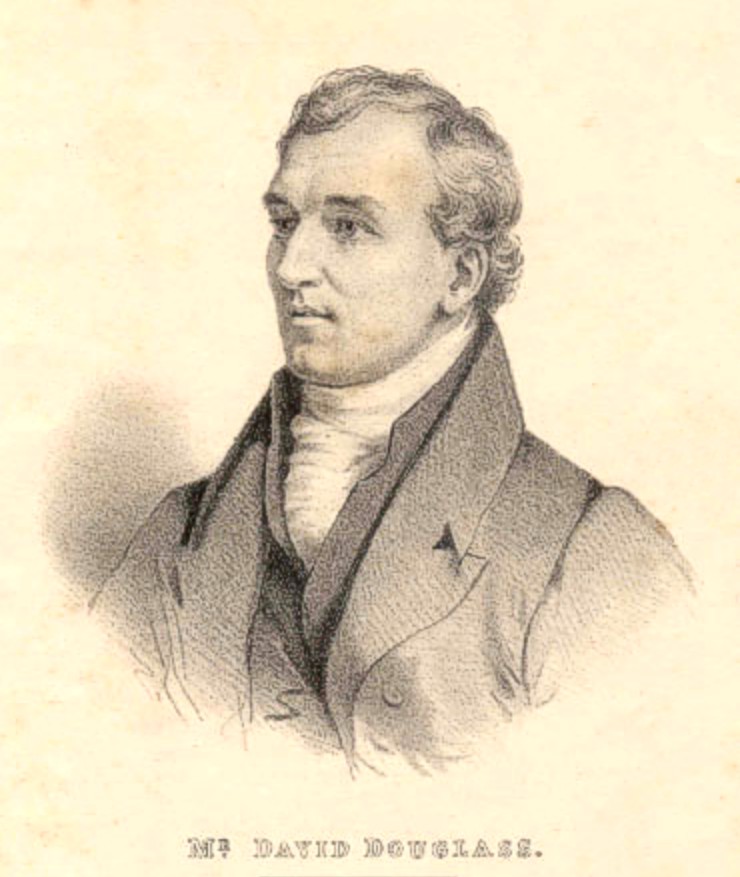
Douglas arrived by ship to Fort George (Astoria, OR.) in 1823. He had been commissioned as a collector for the Royal Horticulture Society to collect any plants unknown to the British Isles. The Gardens of Britain are filled with plants, trees and shrubs introduced from America by Douglas.

Douglas thought nothing of covering up to 50 miles a day on foot through the Wilderness with a 50 pound pack on his back and gun in his hand.
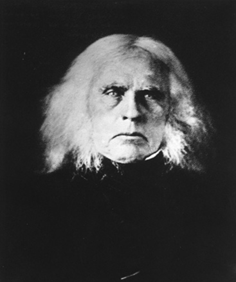
Dr. John McLoughlin

Dr. John McLoughlin

At Fort George, 12 miles upstream, Douglas was a little awed by his first glimpse of the man who was to be his host for the next year, Dr. John McLoughlin, chief factor of the Hudson’s Bay Co., was a vigorous giant, standing six foot four, with a regal bearing, arrogant dark eyes, and a great shock of prematurely white hair. Douglas joined McLoughlin in coming from Fort George up to Fort Vancouver. McLoughlin’s plans called for a fort 750 feet square and 20 feet high, enclosing numerous log buildings.

Douglas made several trips upstream to the Cascades of the Columbia. Douglas hoped to gather a shipment of plants back with the ‘William & Ann’ when she sailed in October. He adapted quickly to the new and rugged life, sleeping at night on a bed of pine or fir boughs or under brush, carrying only a little tea in a tin and depending solely on his rifle for food.
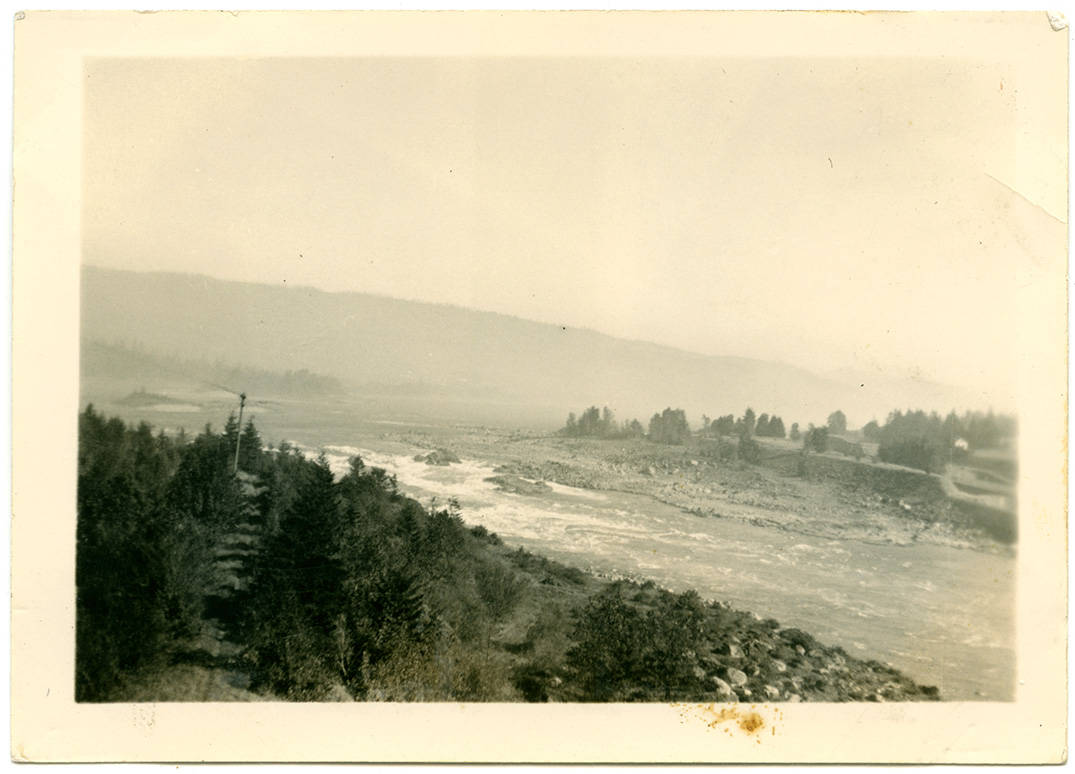
Pre-dammed Cascades. 1912(?) author unknown.

Pre-dammed Cascades. 1912(?) author unknown.

One evening about dark while returning down river. Douglas spotted a a column of smoke rising in the forest near the river bank. Thinking it was a camp of voyageurs, or Canadian boatmen, he landed to join them. He failed to realize his mistake, until he found himself surrounded with more than a hundred braves; he had stumbled on a large Indian encampment.

Fortunately, for Douglas, had met their leader, Chief Cockqua, at Fort Vancouver and the Chief invited him to join their feast. They were eating Sturgeon, a fish weighing five hundred punds, which the had cut up and were roasting in the fires. Between sign language and the few English words that Cockqua knew, Douglas was able to carry on a conversation of sorts, but though the chief appeared friendly, the others watched Douglas suspiciously.

He learned that Cockqua’s braves were preparing for war with the tribe across the river and after the feast almost 300 warriors began to dance around the camp fires, leaping and goading themselves into a frenzy with their keening Death Songs. As the excitement mounted, from time to time a brave would dash intio the light of the Chief’s fire and shake his weapons threateningly in Douglas’ face. As Cockqua sat impassively studying his visitor.

Finally, when many of the braves had dropped with exhaustion, Cockqua announced that it was time to retire and that if Douglas was afraid he could spend the night in his tent. Douglas suspected this was a test also and knowing the Chief’s tent would be full of fleas, he refused. With a nod of satisfaction Cockqua motioned to one of the Indians to throw Douglas a skin blanket.
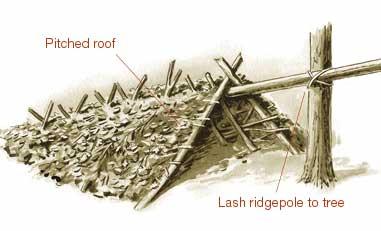
Field & Stream bough shelter. ca.1955

Field & Stream bough shelter. ca.1955

Douglas was aware of the people watching him as he went about his preparations for the night. He built a bough shelter, lit a small fire, then opening his vasculum he took out a number of plant specimens and with great ceremony arranged them in a circle around his lodge as though they were a protective totem.

The people looked puzzled but seemed to understand. No one bothered him that night, but in the morning it was plain Cockqua was not yet ready to let Douglas leave. As a part of their preparations for battle, the Braves staged an archery contest. When one Brave had distinguished himself above all the other, Cockqua motioned that he now wanted Douglas to compete with the Brave. A target was set upon a rock and Douglas hit it with the first shot from his gun. Unimpressed, the grinning Brave did the same with his arrow. Next a target was suspended by a thong from a limb. Douglas hit this too and so did the Brave.

Red Hawk. ©2013 H a v e n

Red Hawk. ©2013 H a v e n

Just then a Hawk flew overhead. Douglas raised his gun to his shoulder, there was a burst of feathers and the Hawk dropped to the ground. Beside him, the Brave grunted as though he had been kicked.

Cockqua smiled enigmatically, refusing to show whether or not he was impressed. He seized a high-crowned hat from one of the people and threw it into the air as though daring Douglas to repeat the feat. Douglas’ shot ripped away the entire crown of the hat. Cockqua picked up the hat, stared at it in amazement, then shoved it down over the owners head so far that his entire head came through. The People seemed to find this very amusing.

‘ The Grass Man is a Great Chief. The Grass Man is a Medicine Man like the Great White Eagle,” Cockqua told everyone.
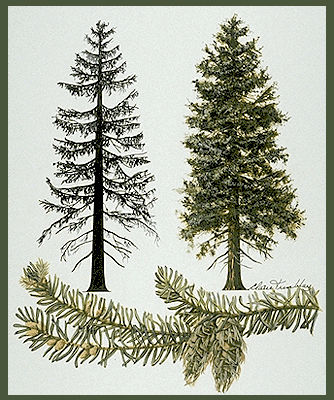
Douglas Fir Tree.

Douglas Fir Tree.

The People did not attempt to detain Douglas further and soon the title, Grass Man, had spread everywhere along the River. Just as the practical Natives could see no reason for McLoughlin to measure the River, they could see no reason for a man to collect plants he could not eat or smoke, so they concluded that this also had something to do with magical powers.

-Retold by Jim Atwell from his book Columbia River Gorge History Volume One (out of print)

How Carson got it’s name: As told by Henry Metzger

Skamania County Pioneer, April 21, 1939

John Skaar and unidentified man. ca. 1913

John Skaar and unidentified man. ca. 1913


“… Prior to 1893, the nearest store and postoffice was at Cascade Locks, Oregon. To get there and back by rowboat was to say the least, very inconvenient. In that year, A.G. Tucker, an old bachelor, started a store in a miserable, tumble-down shack which was built by the sawmill company. The citizens of Carson applied for a postoffice and were granted a twice-a-week mail service. Mr. Tucker, an ardent admirer of Kit Carson, suggested the name “Carson” for the postoffice and the name was adopted without objection. … Before [there was] a postoffice … Carson was known as “Sprague Landing”. …”

I am of Many Stories.

Sometimes when I look at these pictures, I can hear the wind blowing the sweet smell of Spring rains up through the Gorge. I am Indigenous to this very spot, the Cascades on the Columbia, yet, I am the immigrant carrying goods upriver and I am the hands that would build the dam that would silence it forever. I am of many stories.
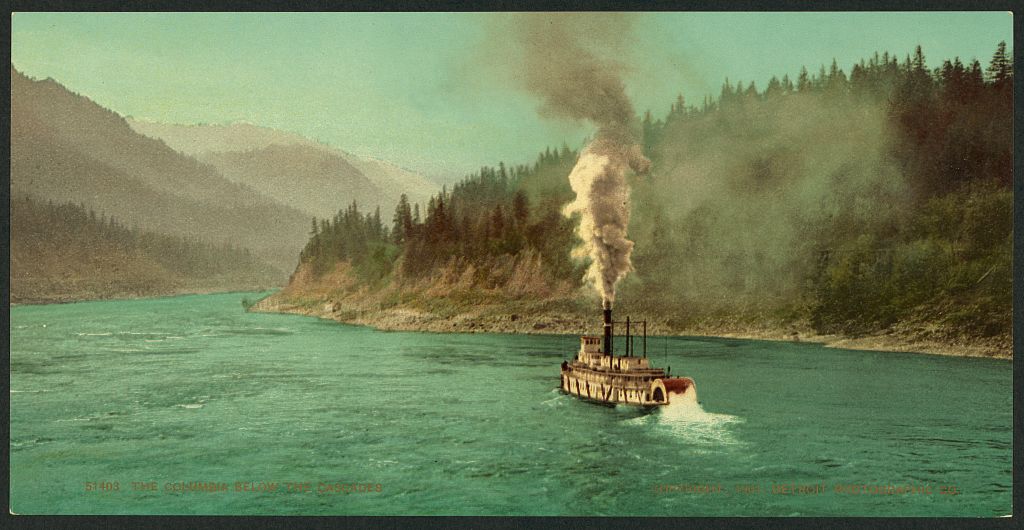
Columbia_River_below_the_Cascades_showing_sternwheeler,_ca_1901

Photo: Columbia River below the Cascades, looking west (downriver) showing sternwheeler, probably the Bailey Gatzert. c. 1901


Hassalo and the Running of the Cascades.

Hassalo ran on the “Middle” Columbia river, that is, the reach between the Cascades and the Dalles, Oregon.

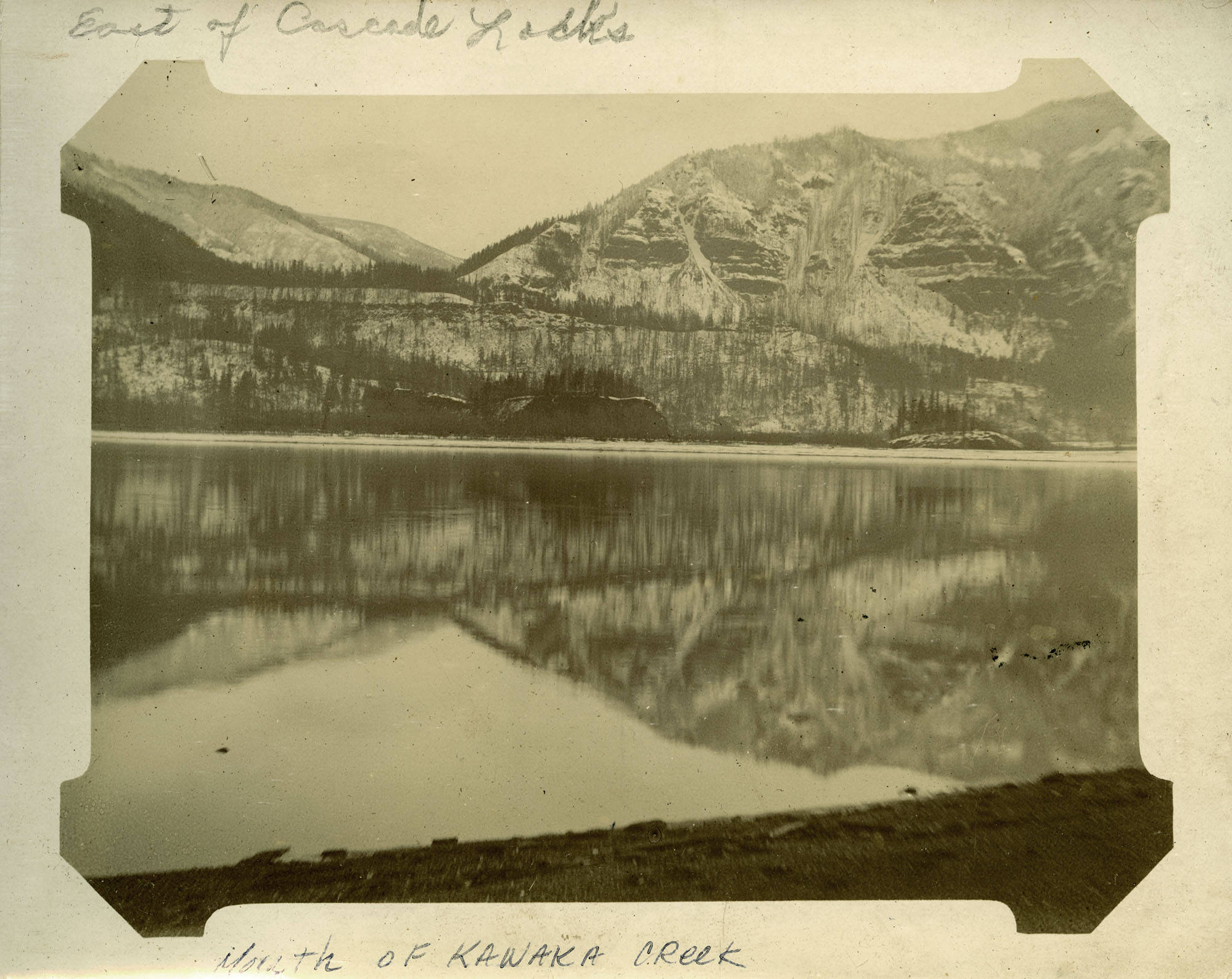
Mouth of Kanaka Creek in Stevenson Wa.

Mouth of Kanaka Creek in Stevenson Wa.

The Columbia river was only freely navigable up to the Cascades of the Columbia, a stretch of rapids in the Columbia Gorge that has since been submerged by water pooling behind Bonneville Dam. Above the Cascades there was a stretch of navigable river going east about 40 miles (64 km) to The Dalles. This reach was called the “Middle River.” After that, navigation was further impeded by a longer series of rapids, the most important of which was Celilo Falls.

Before rail lines were built, travellers bound from Portland, Oregon for Idaho or the Inland Empire generally went by way of the Columbia River. This route was like a series of giant stair steps.

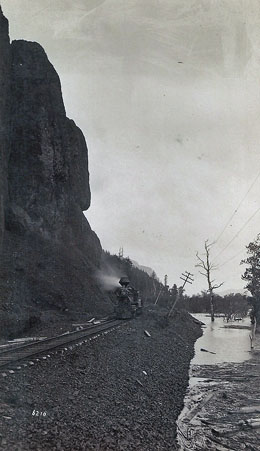
portage railroad below cascades.

portage railroad below cascades.

First, traffic proceeded by steamboat up to the Cascades, where rapids blocked the river to all upstream traffic and made downstream traffic extremely hazardous. This then required transfer to a portage railroad (first hauled by mules, later by steam engines), which proceeded to the top of the Cascades. Travellers then boarded another steamboat to proceed up river to the Dalles, where the process would be repeated for a 13-mile (21 km) portage around Celilo Falls and the other rapids upriver from the Dalles, which like the Cascades were unnavigable both upstream and downstream. This, the middle river, was the route Hassalo ran on from 1880 to 1888.

Train_ColumbiaGorge_1900As railways began to be completed along the banks of the Columbia, the steamboats, tied to the river which required too much loading and unloading of passengers and cargo, proved to be unable to compete, and one by one they were taken off the Middle River. The turn of the Hassalo came on Saturday, May 26, 1888, under the command of Captain James W. Troup. The event had been announced well in advance, and three thousand people gathered along the banks of the Columbia to watch. The channel through the Cascades was six miles (10 km) long.

The Northwest Masters and Pilots Association organized two steamers, the R.R. Thompson and the Lurline to bring crowds up from Portland and Vancouver to witness the event. Describing the excursion up river, the Sunday Oregonian wrote:

Fully 1500 persons were on the ride up the noble majestic stream was an enchanting one. The day was perfect as to temperature, and the scenery was grand; every bend and turn of the river disclosed superb views of mountain, forest and water scenery not surpassed on the entire American continent. Field and marine glasses were in ready demand, and hundreds crowded the decks and admired the grand panorama as it passed swiftly by.

The excursion boats arrived at the Cascades, and the excursionists disembarked on the north, Washington Territory side. There was a scramble up the bank to board the portage train which was to take the crowd to the Upper Cascades where the run was to start. There weren’t enough seats on the train, so a part of the crowd had to wait for the train to run up to the Upper Cascades and return. People had also come down from The Dalles on the Harvest Queen, which ran down to the Cascades with the Hassalo. Other people came up on a train from Bonneville so that there were about 3,000 excursionists overall. As the crowds assembled, both Hassalo and Harvest Queen were at the Upper Cascades wharf with all flags flying. When everything was finally ready, the scene was described by the Sunday Oregonian’s correspondent:

Six loud whistles were given by the locomotive as a signal to the Hassalo that all was ready. … A moment later the Hassalo’s wheel was seen beating the water into foam. She moved gracefully from the wharf, swung round deliberately [.] … [W]ith her sharp glistening prow aimed at the great roaring breach, she shot toward the green rolling masses. From shore to shore the first line of the rapids stretched like a cordon of breakers, and thundering like the tumultuous surf. With a full head of steam, the Hassalo entered the upper break in the waters, and here receiving the first impulse of the mighty current, made a plunge that thrilled the crowd as if touched by an electric shock. ‘There she goes’, exclaimed a thousand voices in low, subdued tones. Crossing the break the steamer rose pointing her bow upward at a sharp angle, and then blindly plunged downward as if going to the bottom; but she came up with the buoyancy of a cork, and now having committed herself to the mercy of the rapids, flew with the speed of an arrow through and over the surging, boiling waters.

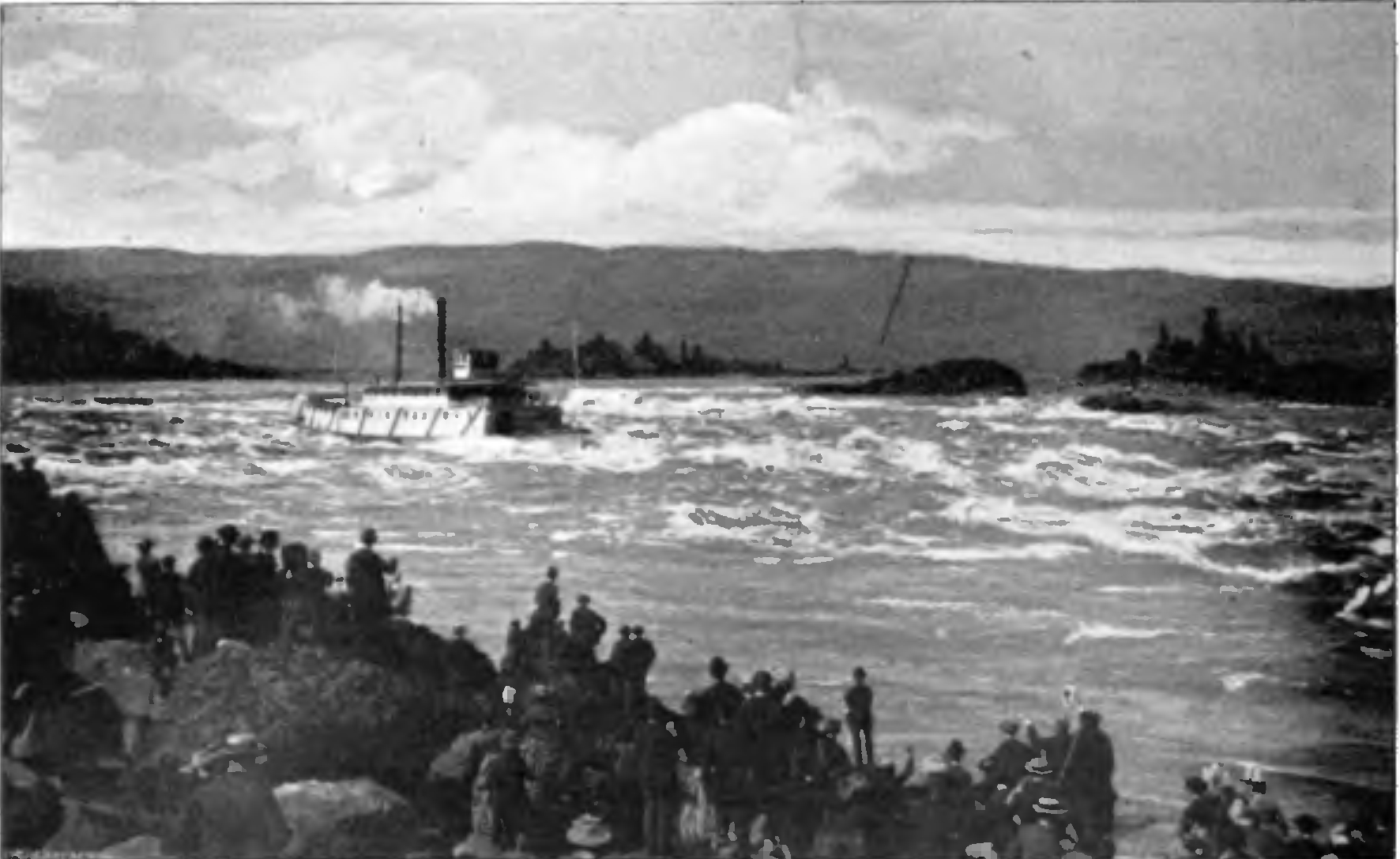
Hassalo running the Cascade.

Hassalo running the Cascades.

Hassalo with just 15 people on board, passed by the people on the bank in just 30 seconds and disappeared from sight around a bend in the river. As she ran down the rest of the six mile (10 km) run, she exchanged whistle blasts with locomotives on the railway tracks besides the river. Once at the end of the rapids, which she ran in seven minutes, Captain Troup took Hassalo down the Columbia and up the Willamette River to Portland.

Remarkable as this was, even the run of Hassalo was not the fastest through the Cascades. On June 3, 1881, captain Troup had taken R.R. Thompson (sternwheeler), one of the same boats that was to run on the Hassalo excursion seven years later, through the Cascades, completing the run twenty seconds faster, and this speed was bested exactly one year later by the R.R. Thompson, itself, when, then, under the mastery of the earlier mentioned and unrivaled riverboatman, Captain John McNulty (steamboat captain). For those times there were not 3,000 people to watch, nor was a famous photograph taken, so the R.R. Thompson runs are largely forgotten by history.

(http://en.wikipedia.org/wiki/Hassalo_%28sternwheeler_1880%29)

Recalling Celilo: An Essay by Elizabeth Woody

Recalling Celilo: An Essay by Elizabeth Woody
from the book “Salmon Nation: People, Fish, and Our Common Home.

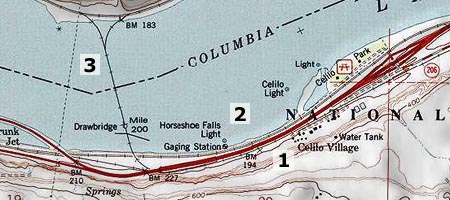
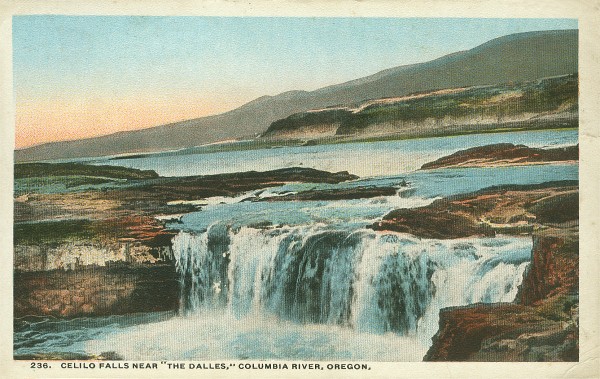
Along the mid-Columbia River ninety miles east of Portland, Oregon, stand Celilo Indian Village and Celilo Park. Beside the eastbound lanes of Interstate celilo0384 are a peaked-roof longhouse and a large metal building. The houses in the village are older, and easy to overlook. You can sometimes see nets and boats beside the homes, though some houses are empty. By comparison, the park is frequently filled with lively and colorful wind surfers. Submerged beneath the shimmering surface of the river lies Celilo Falls, or Wyam.

Wyam means “Echo of Falling Water” or “Sound of Water upon the Rocks.” Located on the fourth-largest North American waterway, it was one of the most significant fisheries of the Columbia River system. In recent decades the greatest irreversible change occurred in the middle Columbia as the Celilo site was inundated by The Dalles Dam on March 10, 1957. The tribal people who gathered there did not believe it possible.

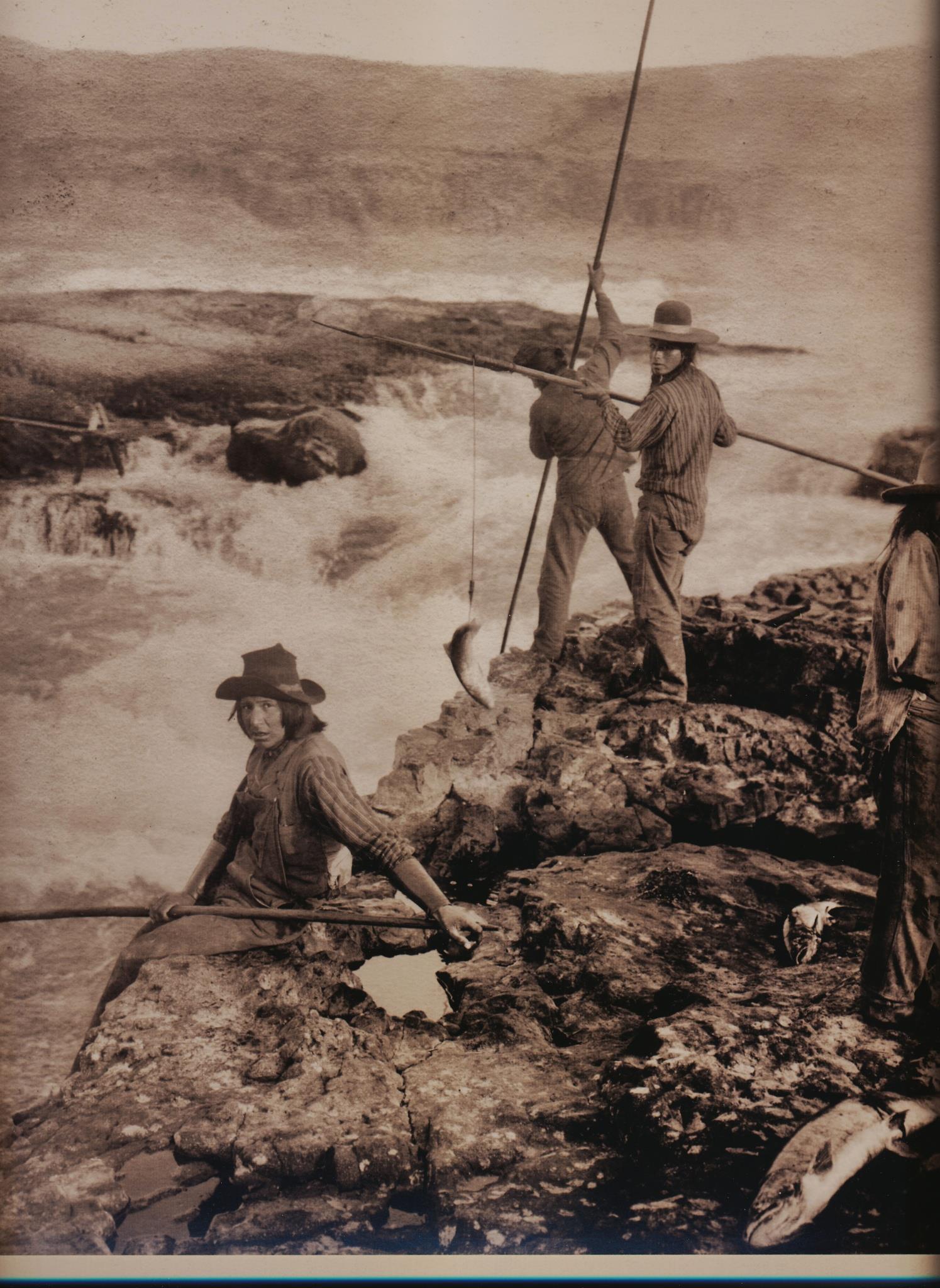
Unknown fishermen, unknown year, unknown photographer.. any information would be appreciated.

Unknown fishermen, unknown year, unknown photographer.. any information would be appreciated.

Historically, the Wyampum lived at Wyam for over twelve thousand years. Estimates vary, but Wyam is among the longest continuously inhabited communities in North America. The elders tell us we have been here from time immemorial.

Today we know Celilo Falls as more than a lost landmark. It was a place as revered as one’s own mother. The story of Wyam’s life is the story of the salmon, and of my own ancestry. I live with the forty-two year absence and silence of Celilo Falls, much as an orphan lives hearing of the kindness and greatness of his or her mother.

The original locations of my ancestral villages on the N’ch-iwana (Columbia River) are Celilo Village and the Wishram village that nestled below the petroglyph, She-Who-Watches or Tsagaglallal. My grandmother, Elizabeth Thompson Pitt (Mohalla), was a Wyampum descendent and a Tygh woman. My grandfather, Lewis Pitt (Wa Soox Site), was a Wasco, Wishram, and Watlala man. But my own connections to Celilo Falls are tenuous at best. I was born two years after Celilo drowned in the backwaters of The Dalles Dam.

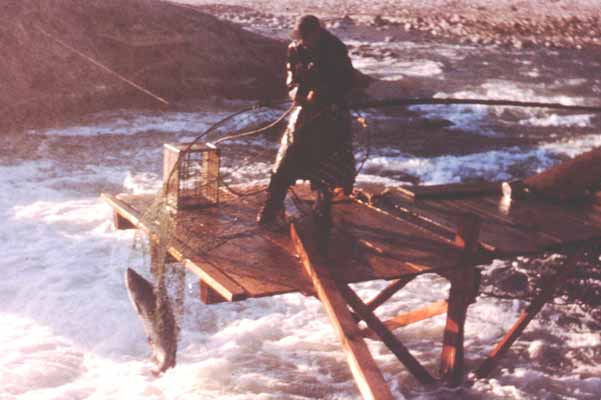
Old unknown photo of a dip-netter.

Old unknown photo of a dip-netter.

My grandfather fished at Celilo with his brother, George Pitt II, at a site that a relative or friend permitted, as is their privilege. They fished on scaffolds above the white water with dip nets. Since fishing locations are inherited, they probably did not have a spot of their own. They were Wascopum, not Wyampum.

When the fish ran, people were wealthy. People from all over the country would come to Celilo to watch the “Indians” catch fish. They would purchase fish freshly caught. It was one of the most famous tourist sites in North America. And many long-time Oregonians and Washingtonians today differentiate themselves from newcomers by their fond memories of Celilo Falls.

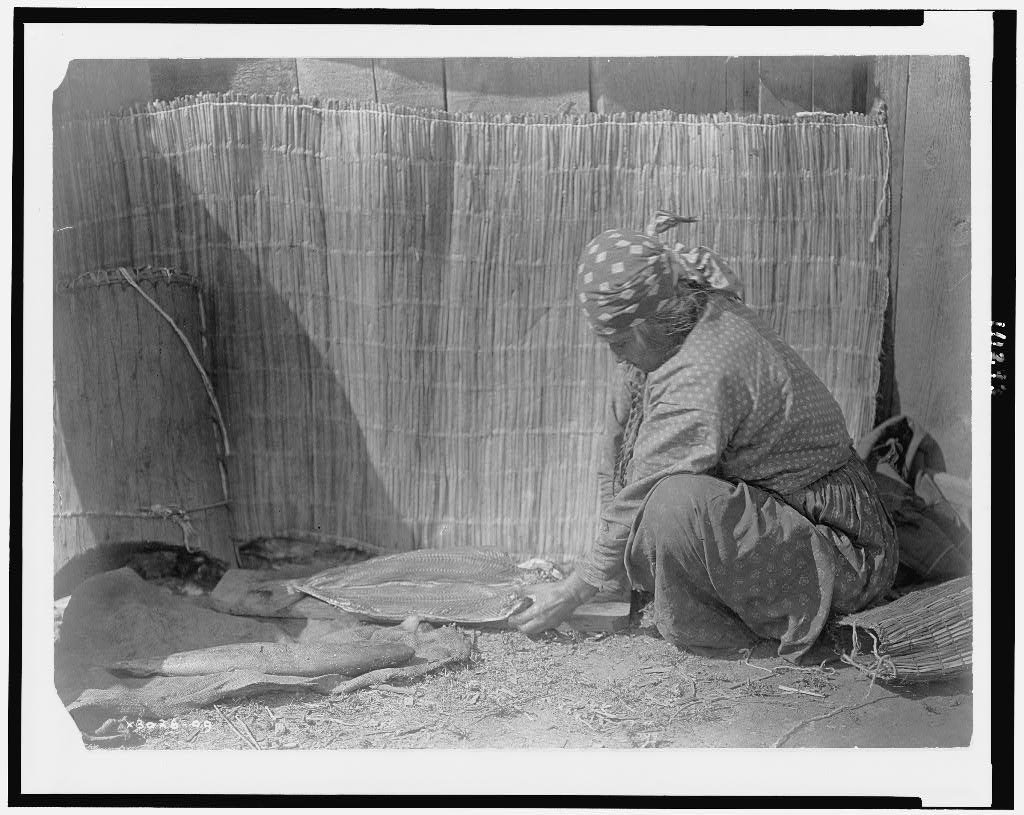
What happened at Wyam was more significant than entertainment. During the day, women cleaned large amounts of finely cut fish and hung the parts to dry in the heat of the arid landscape. So abundant were the fish passing Wyam on their upriver journey that the fish caught there could feed a whole family through the winter. Many families had enough salmon to trade with other tribes or individuals for specialty items.

No one would starve if they could work. Even those incapable of physical work could share other talents. It was a dignified existence. Peaceful, perhaps due in part to the sound of the water that echoed in people’s minds and the negative ions produced by the falls. Research has shown this to generate a feeling of well-being in human beings. It is with a certain sense of irony that I note companies now sell machines to generate such ions in the homes of those who can “afford” this feeling of well-being.

Wishram Grandmother preparing Salmon. Edward S. Curtis photo.

Wishram Grandmother preparing Salmon. Edward S. Curtis photo.

An elder woman explained that if my generation knew the language, we would have no questions. We would hear these words directly from the teachings and songs. From time immemorial, the Creator’s instruction was direct and clear. Feasts and worship held to honor the first roots and berries are major events. The head and tail of the first salmon caught at Celilo is returned to N’ch-iwana. The whole community honored that catch: One of our relatives has returned, and we consider the lives we take to care for our communities.

The songs in the “ceremonial response to the Creator” are repeated seven times by seven drummers, a bell ringer, and people gathered in the Longhouse. Washat song is an ancient method of worship. By wearing the finest Indian dress, the dancers show respect to the Creator.

Men on the south side, women on the north, the dancers begin to move. In a pattern of a complete circle they dance sideways, counterclockwise. This ceremony symbolizes the partnership of men and women, the essential equality and balance within the four directions and the cosmos. We each have our place and our role. As a result, the Longhouse is a special place to learn.

PEO001-00013Meanwhile, in the kitchen, women prepare the meal. Salmon, venison, edible roots, and the various berries — huckleberries and chokecherries — are the four sacred foods. More common foods are added to these significant four on portable tables. Those who gather the roots and berries are distinguished. Their selection to gather the foods is recognition of good hearts and minds. Tribal men who have hunted and fished are likewise acknowledged. One does not gather food without proper training, so as not to disrupt natural systems.

What has happened to Celilo Falls illustrates a story of inadequacy and ignorance of this land. The story begins, of course, long before the submergence of the falls with the seed of ambitions to make an Eden where Eden was not needed. One needs to learn from the land how to live upon it.

The mainstem N’ch-iwana is today broken up by nineteen hydroelectric dams, many planned and built without a thought for the fish. Nuclear, agricultural, and industrial pollution, the evaporation of water from the reservoirs impounded behind dams, the clearcut mountainsides – all are detrimental to salmon. Since 1855, the N’ch-iwana’s fourteen million wild salmon have dwindled to fewer than one hundred thousand.

PC_celilo_falls_near_the_dalles_ca1917

Old Postcard of Celilo.

Traditional awareness counsels in a simple, direct way to take only what we need, and let the rest grow. How can one learn? My uncle reminded me that we learned about simplicity first. He said, “The stories your grandmother told. Remember when she said her great grandmother, Kah-Nee-Ta, would tell her to go to the river and catch some fish for the day? Your grandmother would catch several fish, because she loved to look at them. She would let all but two go. Her grandmother taught her that.”

A larger sorrow shadows my maternal grandmother’s story of the childhood loss of the material and intangible. What if the wild salmon no longer return? I cannot say whether we have the strength necessary to bear this impending loss.

The salmon, the tree, and even Celilo Falls (Wyam) echo within if we become still and listen. Once you have heard, take only what you need and let the rest go.

Elizabeth Woody (Navaho/Warm Springs/Wasco/Yakama) received the American Book Award for her collection of poetry “Hand into Stone.” She is the Director of the Indigenous Leadership program for Ecotrust. This essay is adapted from Salmon Nation: People, Fish, and Our Common Home.

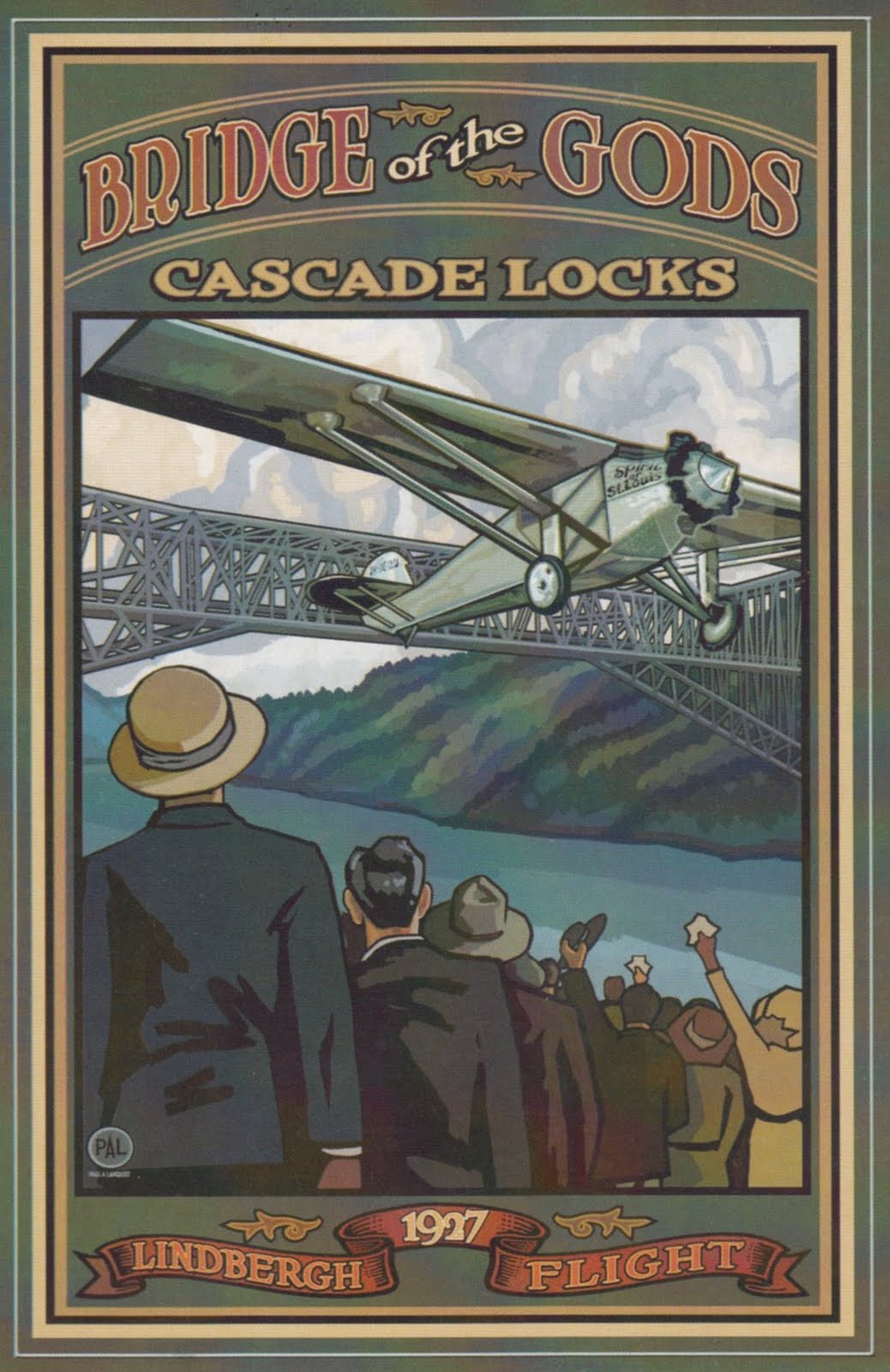
Charles Lindbergh and the Bridge of the Gods

September 1927, following Charles Lindbergh’s trans-Atlantic flight in May, Colonel

A post--card from the event.

Artist: © Paul A. Lanquist (“PAL”)

Lindbergh himself flew up the gorge from Portland in his famous Spirit of St. Louis, passing low over the new Bridge of the Gods, banked his plane and in a dramatic show of barnstorming, flew under the bridge and headed back to Swan Island.