Jello made its way into my family’s DNA—one molded and folded, whipped and loaded potluck after another, it became a part of our family tree. Growing up, the space-aged gelatin treat was present at every gathering and on every road trip. In the mountains, around the fire, we’d pass around Tupperware filled with finger jello, sometimes encasing unsuspecting maraschino cherries in its gelatinous embrace. Or we’d enjoy raspberries whipped with Cool Whip, baptized in cottage cheese-textured bliss. But my mother’s Green Stuff was the stuff of legends—a true crown jewel among the Potluck Queens.
It was a mystery, a secret recipe passed down from Sunset magazines and the backs of cleaner boxes.
“Jules, what’s in that?” people would ask. “It’s a secret,” she’d reply.
It tasted of pistachios and cottage cheese, walnuts and grapes. Heaping green mounds adorned our cousins’ plates, alongside Grandma’s chicken and the promise of safety.
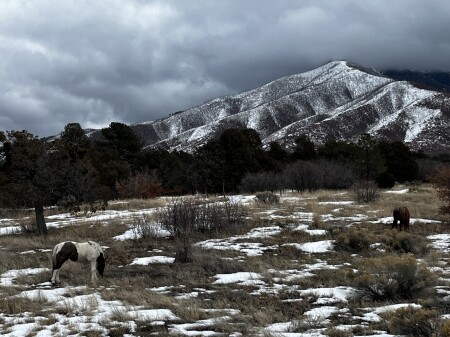
Ravens fly mid thought across the white backdrops of Sangre de Cristo peaks, descending in hushed lines of wind brought together through patterns and will- stingy in the knowledge of flight. I watch sad and mad in my jealous indignation at such a feat. Perhaps it is the plight of the human to have to deal with heartbreak, bills and 9-5 because we forgot how to fly ourselves.
The air was heavy with the scent of possibilities, mist mingled in fire smoke and ravens wings.
Did you know that the black we see in the raven is not black at all but a spectrum of rainbow light so distinct and grand that only the chosen may glimpse.
I have always wanted to be chosen by the raven- to be seen, to fit in. to be a part of something only registered as a secret- to be a key holder to esoteric knowledge and the divinity of unseen light.
The mountains sang in up drafts and bitter wind, songs of a corvid knowing echoing beneath basalt and longing.
I looked up by chance, to see an Eagles dance- and a song of Fuck You to the Raven brood. I assume it is because they shine like the sun, and Eagles are jealous too.
And you know the sun’s settin’ fast
And just like they say, nothing good ever lasts – Iris Dement
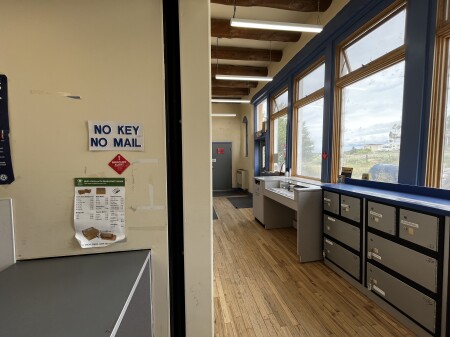
Caught up with Ana at the San Cristobal post office, where the Sangre de Cristo Mountains keep watch and the air smells of sage when the wind shifts. She’s always got her hands busy; sorting mail, humming under her breath, listening more than she speaks.
She tells me things were different once. Her mother remembers when Dennis Hopper might be seen at the café in Taos, drifting in with the sunrise, pockets full of stories and rumors. Back then, folks say D.H. Lawrence wrote letters just up the road at his ranch, chasing words like they were wild horses. Ana says it felt like all kinds of people passed through—artists, poets, wanderers—leaving a trace of themselves in the dust and laughter that filled old adobe porches.
Now, Ana sorts through postcards from Santa Fe, the odd letter from grandkids in Albuquerque, bills addressed in shaky handwriting. The bulletin board out front is cluttered with lost dog flyers and sun festival announcements, a faded poem tacked up by someone who never signed their name. It’s quieter these days, she says.Stories get traded softly, almost like apologies.
She pulls out a letter addressed to “The Friend I Miss.” Says sometimes she finds a book tucked in a parcel, or a clipping about Aldous Huxley, who once wandered these mountains and left behind only rumors and a few lines about the light. There’s always a stack of undeliverables; a map with trails nobody walks anymore, postcards with no addresses, messages that seem to drift in from another time.
I ask if she misses the old San Cristobal. She shrugs, says the world turned inward; most folks wave from behind car windows and screens now, and even the newcomers with dreams of writing keep mostly to themselves. But sometimes, when the Sangre de Cristos catch fire at dusk and the cottonwoods whisper with the river, Ana swears she can still feel the old magic—just a heartbeat away, just this side of dreams.
“Some folks call her a runaway. A failure in the race. But she knows where her ticket takes her. She will find her place in the sun”
― Tracy Chapman
Wilma stands beneath the sour glow of the Dollar General, the jaundiced sign humming over sage and river stones. Inside, the aisles are bright with plastic—candy-bright, memory-light—replacing the smell of bread that once crept from shuttered doors just down the road.
She rings up locals—faces creased by wind, pockets heavy with worry—stories trading hands like loose coins: a missing dog, a sun-festival in a canyon, a brother lost to the blues. Wilma gathers them in, her touch gentle as rain on dust.
At closing, she slips outside into the blue hush, mountains looming—watchful, bruised. She lights her menthol, exhales halos and steps under the holy light of neon, flickering behind her as coyotes call just beyond the shadows. Wilma walks home, steps soft as moth wings, carrying the day’s small losses, still searching for wild iris, just this side of dreams.
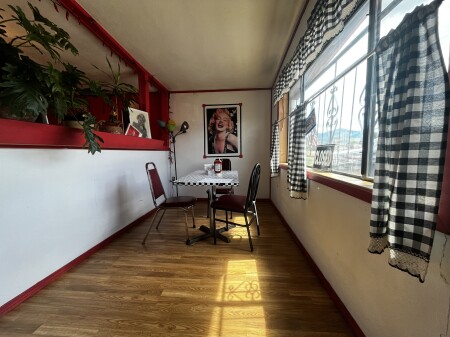
Rosaleen unlocked the door at eleven, the screen creaking open as pale dust danced in the shaft of morning light. The diner was quiet, its checkerboard curtains catching the sun, red trim glowing against the hush that filled the space.
In the kitchen, Tia was already at work, hair tied back, moving with a calm efficiency through the rising scent of chile warming in the pan. She hummed something old, her tune for no one but herself, as steady as the rhythm of her hands.
Out front, Rosaleen wiped down the Formica counters, set the forks straight, and checked the register. The visitor log lay open, names drifting across the page in blue ink—Wyoming, Berlin, Austin, even a doodle of a mountain. Locals knew to come after noon, their boots heavy, their stories heavier. Tourists arrived earlier, the screen door snapping shut behind them as they glanced at the Marilyn Monroe prints, the pie safe, and the handwritten sign:
“Breakfast All Day / Open 11-5.”
Coffee was poured, pie was served. Rosaleen’s voice was gentle, with just a trace of her grandmother’s Spanish in it—her cariño, soft as a secret, slipping into the morning air.
In the far corner, the jukebox played a song just out of reach, something slow, a melody that tasted of Patsy Cline and sunlight warming old tile. Tia called out orders in a timid voice that brooked no argument, red chile glistening as she wrapped burritos tight in Christmas colors. Rosaleen’s laughter mingled with her aunt’s in the steam and clang of pans.
The hours slipped by, measured in coffee refills, the sighing hush of the screen door, and the ever-growing list of names in the visitor registry—a traveler from Maine lost on the backroads, someone from El Paso, someone else just passing through.
At five, Rosaleen turned the sign, rinsed the last mug, and listened as the jukebox winds down its last dance- “I go out walking, looking for you”- She stood by the screen door with sunset falling across the empty booths, thinking of all the names left behind—lost, just on the other side of dreams.
I gave an old hippy named Willy a ride- he told me about heartbreak and being a hermit- told me I was on my way and let me know there is nothing to worry about.
He writes songs and said he just came from a festival they named after the sun- it was nestled in a canyon near Red River, I assume the festival is for the appreciation of light.
He hits my vape and tells me about the time he flew, car decided to try out for being an angel- forgot to get permission waivers from Willy.
He laughs and shows me old scars, coughs, tells me the weed these days is too strong.
He gets out, trailer 23, just this side of dreams.
“I need someone to show me the things in life / That I can’t find /” – Black Sabbath
Whites of eyes strained in the sun, they sat rubbing the crust from hard pupils.
“I have never seen the other side of the sun, have you?” Kindred asks, biting their parched lips.
“Once, when I was interdimensional, I swooped in for a gander. It is unlike anything you have ever seen.” Cameron proclaims.
“How so?” Kindred replies.
“Would you like to see?”
With that Cameron pulls out his satchel that holds the keys to the skies and raises it up to Kindred’s face. They focus their eyes like an Eagle, pin point meaning and softly reply.
“Sure, I would be interested in seeing the dying sun.” They say.
In a sacrament of smoke, they traced the sky open, pulling stars into mass, and with a slip of the wrist, blast into infinity. The voyage opened to the constellations drawing tracers against warm faces. Higher and higher they flew- souls adrift the apex, thrown through universes. Taking the long way home, until the faint glow of the sun exploded into fire, and then darkness.
“Oh, it’s a feeling, isn’t it?” Kindred asks. “The black hole sun, it is a feeling”
“Magic is afoot, God is alive.”- Buffy Sainte-Marie
Her dreams whisper reassuringly in journals bound in leather, the engraved cover gathering dust in the creases of her ancestors’ knotwork—mythology and aesthetics rendering the heart through time. The company of rocks, feathers, and photos stand astute as altars to memory, lining the halls of nostalgia with flowers, dried and pressed.
A richly painted sunset grows silent in sleeping eyes. As if preparing herself for ritual, she lays the journal on the tiered nightstand—the bond of dreams now past, yet ever present in the great rites of a secret society. Curious shadows drape the night, and words fall from her sleeping lips. Will those words find their place, engraved in the leather-bound journal of her heart?
The delinquent voices sing the praise of night’s great sermon, ushered forth through pens whose ink refuses to run dry. The extravagant want of knowing sits in a curious corner—the holder of shadows and fields of exhausted dreams. I wonder what she writes as she scribes the visions of a reluctant Sage. What great prophecy does the night entail in these pages lined with words? What monsters lie slain at the feet of her gods?
In the high noon of a winter’s day, when light strains through the milky-white shutters and the bustle of waking life dances the dance of routine, the old journal sits. What silent conversations must happen in these churches of dust? Do the rocks tell stories about how they were born of volcano and have lived to witness the Anthropocene? Does the Phoenix silently gather back its dormant flaming feathers? Do the flowers speak of their once-great pageantry, before being pressed and fitted into their eternal form? Does her father escape his photographic prison to share stories of his daughter’s great feats? The totemic dragonfly lamp stands guard atop its utilitarian box-made mountain, draped in cloth and stone-made coasters, ready to sound the alarm of the creator—an ushering of quiet, as not to give their animism away.
The tapping of the pens scribes great scripture, a drum that eternally beats in time with her heart. A calligraphy of the soul, draped in esoteric symbols meant only for her sacred eyes, spans the enormity of dream, nightmare, and waking life. It tethers her to the divine and unravels the great inferno. There must be so much beneath those covers made of leather: seas upon seas of tear-drenched papers, brought from the clouds of grief and sadness, or the suns of joy and peace. The stories of grandbabies and daughters whose hearts are hers, whose blood pumps forth the changing face of family. All these stories, wrapped and tidy, made from the love of a well-lived life. All the stories where the beast is slain with great bravery and skill, as not to disturb her loves from sleep. The holder of the flame, the Phoenix from the ashes: a journal.
“Hope is the thing with feathers
That perches in the soul
And sings the tune without the words
And never stops at all.” – Emily Dickinson
~
There are numbers zipped up in code that distinguish a place. A place where the mailman sometimes drives a mile or more to the next box; markers upon a black sea of asphalt, gravel and rain. Toivo lived here, amongst the mapleway and dirt trails- snags of trees swaying in the wind. A psithurism cathedral, with halls that echoed Finnish Polkas in a land of make believe. My Grandfather came from an old world, yet made a new one in the mossy twigs of 98648.
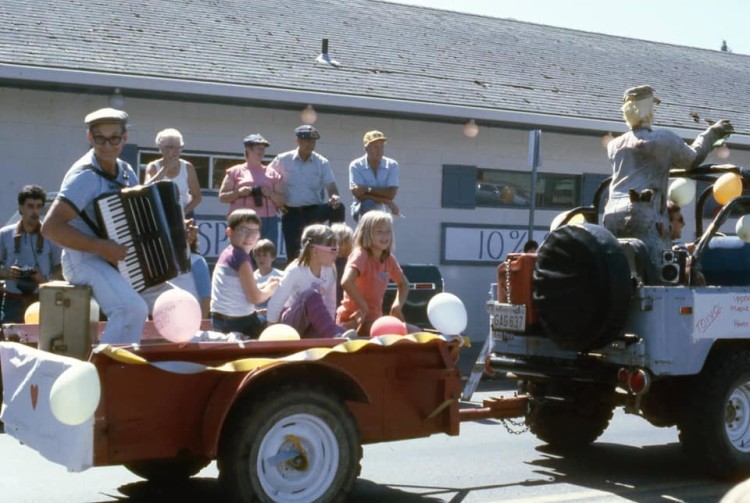
I am the oldest of 10 grandchildren, and arrived into a world filled with imagination and music. My grandfather played the accordion, spoke Finnish when drinking with his brothers and sisters, and loved to tell good stories. My oldest memories are set to the soundtrack of joy, laughter, and the Chicken Dance. Gramps had instruments in every corner and nook- amongst the dusty wisps of paper scrolled upon with poems, music, and blueprints for building. His hands were always inventing something new. When I was 9, he invented Toivo Land.
Toivo was an imaginary friend he made out of sawdust flesh, dressed in cover-alls, and who wore a face of permanent marker drawn upon a milk jug. Toivo always sat on an old Ford tractor that was rusty and splintered (unless he was out and about with the Toivo Land Band.) Toivo was a Magician, and like the Wizard of Oz, Toivo plowed a yellow brick road dotted with hand painted signs, and paved with the falling leaves of Maples, Oak, and Fir. A network of discovery that spanned 3 acres, and a lifetime. Toivo was always busy- this was Toivo’s land.
Toivo: 1) Finnish toivo = ‘hope’, ‘wish’, ‘desire’ 1 a) … with an older meaning ‘faith’, ‘trust’, ‘promise’
(Photo of Toivo Land Band @ Skamania County Fair Parade, Stevenson, WA. 98648 , cir. 1984)
~~
The faint sound of Polka seeping from old cassettes keeps time with the machines monitoring his breathing. His heart beats sporadic metronomes to his Covid-19 fever dreams. His fingers fold in on themselves- clutched and cold. It has been awhile since he has held the weight of billows and keys strapped upon his stern shoulders. He is quiet and ready- ready to make music again.
“Thank you,” I sob a hard sentence, stuck in my throat made of his flesh, “thank you Grandpa for always being there, and making our lives magic, and filled with love.”
“Thank you Grandpa for Toivo!”- I strain the words between tears that fall upon my pandemic shield made of plastic.
We lock a gaze of Finnish silence, the kind of silence filled with the solidarity of *Sisu. A stoic tear moves its way down his ageless face of wisdom, and with a side quiet smile, he says:
“It is all I could have hoped for!”
“It is all I could have hoped for.”
———————————————————————————————————————
* Sisu is a Finnish concept described as stoic determination, tenacity of purpose, grit, bravery, resilience, and hardiness and is held by Finns themselves to express their national character. It is generally considered not to have a literal equivalent in English.