The Road to Oceti Sakowin Camp: Stories From the Lines

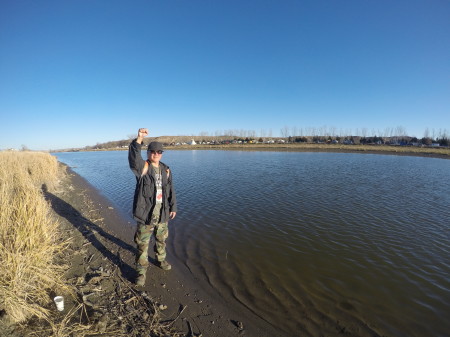
His voice is heavy with the weight of struggle, yet stands tall with determination and will. His name is Christopher Francisco, a proud Navajo Diné brother who was one of the last to feel the effects of the Indian boarding school system and its manifesto of ‘kill the Indian, save the man’. Christopher is a strong and solid soul who cares very deeply for the Earth and his People and has been very active in defending their Sovereignty.

DCIM100GOPROGOPR0216.JPG We have become fast friends and I have learned a great deal from his wisdom. We have started working together on story gathering projects here at Oceti Sakowin Camp during this time of struggle against the North Dakota Access Pipeline.

Listen to his Story.


Celilo Falls, Standing Rock and The Dream.

I dreamt of Standing Rock last night, except it was Celilo Falls. Thousands had gathered to protest and block the U.S. Army corps of Engineers from flooding our Sacred falls.

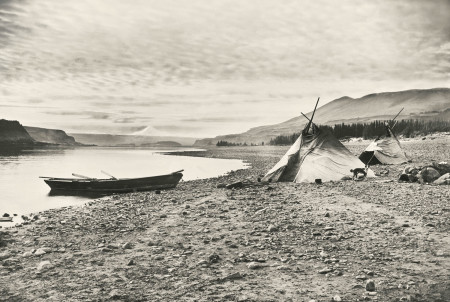
Home Guard on the Columbia, by Benjamin A Gifford (1899) (photo- courtesy The Valley Library, Oregon State University)

Home Guard on the Columbia, by Benjamin A Gifford (1899) (photo- courtesy The Valley Library, Oregon State University)

I awoke from the dream in great lament and sadness. I am feeling pulled by the Salmon People to stop this monster of a snake and lend my body to help protect our Mother! And take a journey to gather the stories of the People who are taking a Stand to stop the North Dakota Access Pipeline (#NODAPL) at Standing Rock. I wish to document and gather stories of the Elders, the Children, and any and all who feel this draw to make a stand to flip the current paradigm of our Sacred Mother. I want to document what it means to be indigenous to a place, and to put your life and prayers into protecting it.

I am planning on leaving Monday, October 31st, 2016, from Olympia, Washington with just enough money (I have been dealing with serious health issues the last 5 months and have been out of work), but have many prayers that we (there is two of us) will be provided for.

We Are Water! photographer unknown

We Are Water!
photographer unknown

So I am humbling asking folks to donate to our Standing Rock fund (also linked below) to help us pay for the journey east to North Dakota. We will be traveling in a large utility van and wish to bring supplies (you can find the supply list here) to the Water Protectors as they hunker down for the Winter and the long fight ahead. So please, if you can not donate financially, help out by donating supplies for us to bring over! If you wish to send supplies with us, please contact us!

Many Blessings and All Our Relations!


A Fierce and Mighty Wind

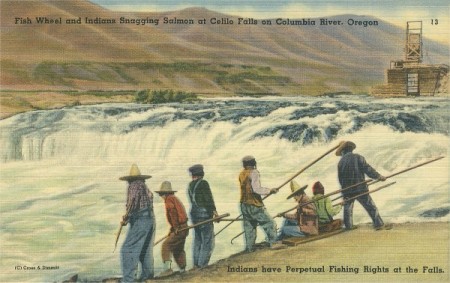
The fish wheel in the back ground looms like a dragon, ready to pounce, and devour a way of life, hungry and impermanent. I often dream of the other years,

Celilo Falls, post card. ca. 1930

Celilo Falls, post card. ca. 1930

but often find myself barely able to remember how to fish as I browse the supermarket aisle for the freshest caught bargain. Irony showers my existence. I feel like there is this wind that is blowing so hard it will knock the ‘Indian’ right out of me. I watch the flat surface of the lake that now covers the “echoes of falling water”, and see my cousins being shunned from their tribes for not having enough blood-quantum, and tribes, such as the Wy’am and many Columbia River Indians, not being seen as a Sovereign Nation and I feel lost. To be honest, Gathering the Stories is my anchor, or stump, you could say, to this wind, and I must say, it scares the living shit out of me to know that my offspring will no longer be considered part of a tribe.

Reading links:
Read about Celilo Falls from the Columbia River Inter-Tribal Fish Commission here

Read about the dis-enrollment of Chief Tumulth’s descendants from the Grande Ronde Tribe based on blood-quantum here

Read “Recalling Celilo: An Essay by Elizabeth Woody” from the book “Salmon Nation: People, Fish and Our Common Home” here

Valentines Day Origins

The time is nigh for the Cupids of the world to indulge themselves in hallmark chocolate and prompted flower buying.

The modern market for Cupid.

The modern market for Cupid.

Why this one day to lay
our souls on the line to our sweeties? Why the mass love fest on February, the 14th?

The origins of the chocolate orgy we call, “Valentines Day”, came from the Romans, who celebrated a ritual called, Lupercalia. Lupercalia dates way back, even before the Romans decided to get arrogant and help invent Imperialism, the Romans celebrated Lupercalia. It was a ritual that was observed on February 13 through 15, to avert evil spirits and purify the city, releasing health and fertility. How did they do this?

The Lupercalian Festival in Rome (ca. 1578–1610), drawing by the circle of Adam Elsheimer, showing the Luperci dressed as dogs and goats, with Cupid and personifications of fertility

The Lupercalian Festival in Rome (ca. 1578–1610), drawing by the circle of Adam Elsheimer, showing the Luperci dressed as dogs and goats, with Cupid and personifications of fertility


The festival began with the sacrifice by the Luperci (or the flamen dialis) of two male goats and a dog.[10] Next two young patrician Luperci were led to the altar, to be anointed on their foreheads with the sacrificial blood, which was wiped off the bloody knife with wool soaked in milk, after which they were expected to smile and laugh.

The sacrificial feast followed, after which the Luperci cut thongs from the skins of the animals, which were called februa, dressed themselves in the skins of the sacrificed goats, in imitation of Lupercus, and ran round the walls of the old Palatine city, the line of which was marked with stones, with the thongs in their hands in two bands, striking the people who crowded near. Girls and young women would line up on their route to receive lashes from these whips. This was supposed to ensure fertility, prevent sterility in women and ease the pains of childbirth.

Now, let’s go buy some chocolates.

Ghost in the Land of Skeletons | Christopher Kennedy

Ghost in the Land of Skeletons
For Russell Edson

'Ghost Train' | © 2015 H a v e n

‘Ghost Train’ | © 2015 H a v e n

If not for flesh’s pretty paint, we’re just a bunch of skeletons, working hard to deny the fact of bones. Teeth remind me that we die. That’s why I never smile, except when looking at a picture of a ghost, captured by a camera lens, in a book about the paranormal. When someone takes a picture of a spirit, it gives me hope. I admire the ones who refuse to go away. Lovers scorned and criminals burned. I love the dead little girl who plays in her yard, a spectral game of hide and seek. It’s the fact they don’t know they’re dead that appeals to me most. Like a man once said to me, Do you ever feel like you’re a ghost? Sure, I answered, every day. He laughed at that and disappeared. All I could think was he beat me to it.
- Christopher Kennedy

The Drive

'Chehalis' | © 2015 H a v e n

‘Chehalis’ | © 2015 H a v e n

A thirst lingers even when the rainy seasons fall. A thirst for old ways that seem to be eaten by the rusty splinters of time. Injected with the last breath, tree gives way to steel, steel gives way to silicone. I sometimes get in my car and drive as hard and as far away as I can, where stories still linger in old dusty corners, and the quiet nod of the neighbor is the loudest conversation heard all day. I drive until beauty overwhelms my senses, pull over and exhale. I drink in the mists, eat the landscape and remember how to pray.

'Dream |V' | © 2015 H a v e n

‘Dream |V’ | © 2015 H a v e n

I use to pray, even if the sounds echoed into empty space. I felt some faith those words would reach some distant star and portals would open up in the night sky. But, instead, I would dream. I would dream until I forgot it was I was dreaming about, what was the reason for the journey? I often find the journey is the only thing that keeps me still, most times, nodding off to the narcotic rhetoric of the modern age. It is in these journeys, I meet my guides, who, with unforeseen hands, move the air of the fates in and out of existence and Coyote always seems to wake me up right before the climax. Now I pray to keep this car on the road as it climbs into the mists of unseen vistas, comprehending god.

'Pleasant Hill' | © 2015 H a v e n

‘Pleasant Hill’ | © 2015 H a v e n

Myth, I believe is subject to the winds of which it is blown. Times have changed, and times are changing, but the story tellers are lost behind their reality TV shows and quick fix GMO hungry man. Myth, feeling lost, stagnant, forgotten, found homes in the catharsis of our youth. And sometimes, judge Judy and Jerry Springer are the only story tellers we have left. So be it. I will keep driving, and if some one stops to share a bit of forgotten, timeless wisdom, I am all ears…..

The Hatfield and McCoy’s of Skamania County

ALL NEIGHBORS NOT GOOD IN COUNTY’S EARLY SETTLEMENTS (Published in Skamania County Pioneer January, 1949)

“Neighbors” in the pioneer days of the county were not always “good neighbors,” according to Henry Metzger, pioneer Carson resident who this week recalled some of the occurances enlivening the early days in Skamania County.

The Hatfield clan from the famous Hatfield and McCoy conflict.

The Hatfield clan from the famous Hatfield and McCoy conflict.

“Much has been, and still is, said and written about the pioneer spirit, the spirit of neighborliness, mutual assistance, courage to take and solve difficult problems as if, and it is true, much of that has been and still is in evidence in this neck of the woods, but it would be folly and serve no good purpose to tell the now growing up generation that everything was sweet peace and harmony among the early settlers, for such was not always the case. Fact of the matter is that, in my opinion at least, there is now much more harmony among the neighbors than there was only about a half century ago. The reason for this I contribute to a much higher standard of education and to the fact that country life is getting more and more like city life, where you often do not know your next door neighbor.

Random photo of a fellow on Larch Mountain during the 1930's.

Random photo of a fellow on Larch Mountain during the 1930′s.

“Maybe I can best illustrate the pioneer spirit by telling of an incident that, I am told, happened in Skamania County about 60 years ago. There were two prominent citizens, joint farmer-neighbors, who could not get along together well. They could not smell one another, so the saying goes. They were not on speaking terms and when they met at public meeting they would oppose each other even if they were of the same opinion on the subject under discussion. It so happened that one of those farmers had hay on, ready to haul in when it looked as if the weather would turn to rain. He started hauling in hay, him on the wagon and his wife, a frail woman, pitching on the hay. But soon his ‘despised’ neighbor appeared and walking up to the woman said in a harsh tone, ‘Give me that fork and you go to the house, that’s where you belong,’ and he started in pitching on the hay and these two men worked for hours together, never speaking a single word to each other, not even would they say ‘thank you’ or ‘good bye’ when they parted after the hay was all in the barn.

“This is what I would call the ‘the Pioneer Spirit in the Rough’.”

Tale of the Cedar Stump House

There are some places some people should not know of, some places where a smile and a nod, and the mile posts of stumps, gives you the key to another world.
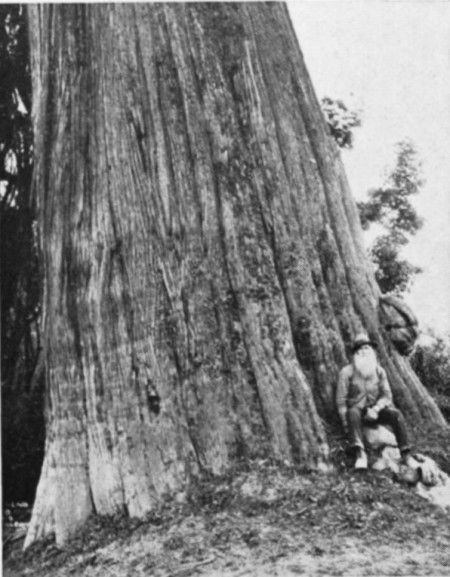
Willapa Hills Cedar tree, photo unknown, ca. early 1900's

Willapa Hills Cedar tree, photo unknown, ca. early 1900′s

I first heard of this elusive Cedar Stump house from an old timer at the Pe Ell Pub one night, after a long round of Busch Lights and lines of stories. We were talking about his family and how they settled down here in the Willapa Hills over a 150 years ago. “The forest was a lot different back then”, he told me, rubbing his belly as if to move the words. He told me about, how back in the day, ‘the trees were so big you could live in them, I tell you know lie, in fact, I know of a place that you can live in one. It is an old Cedar stump out in Pacific County. The darn thing has a window, a door and a roof on it.” Not sure what year they made that stump a home, but I am pretty damn sure the old thing is still standing!” Of course this perked my investigative ears to the possibility I would find such a magical kingdom hidden in the hills of mists and moss.

As time went on, I kept asking the local folks questions IMG_20130209_211011(I consider myself a local but I need to live around here for 10 years, to become an “official local”, I am told.) about this elusive fairy land that had captured my imagination. Some people were reluctant to speak of it’s whereabouts, as if holding on to an old code of silence, looking me over with suspicious eyes. I would ‘prime the pump’ with cheap beer to get the lips telling stories, and got little clues. Most would boast about taking their girlfriend out there and writing their names on the holy grail of the ‘Stump”.
IMG_3485

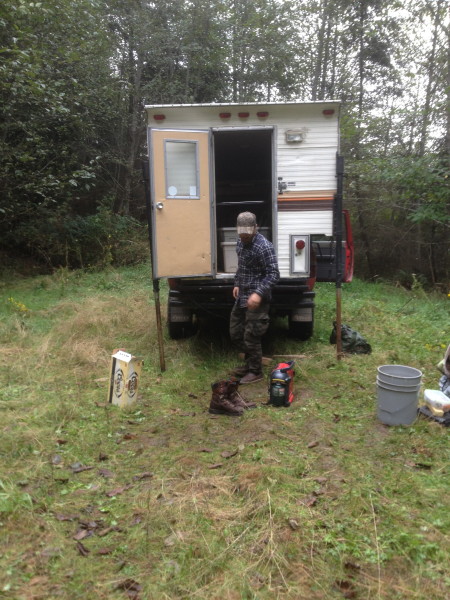
Elk Camp 2014

It was not until I was helping a close friend with some tracking and hunting up in the Willapa Hills, did the biggest clue come. It sailed in on the setting sun, dressed on the wings of a Red Hawk, flying low above our packed Elk Camp caravan. It swooped through light and disappeared into the moss covered trees. At that moment, I looked down to see an old bridge, half rotted from the relentless rainforest mist, and heard the old timers voice in my head: “There is an old bridge…”. That night in Elk camp I laid half awake, listening to the call of cows echoing through the mists and pondered my earlier thoughts of the elusive eden, and made a vow to find it after the hunt.
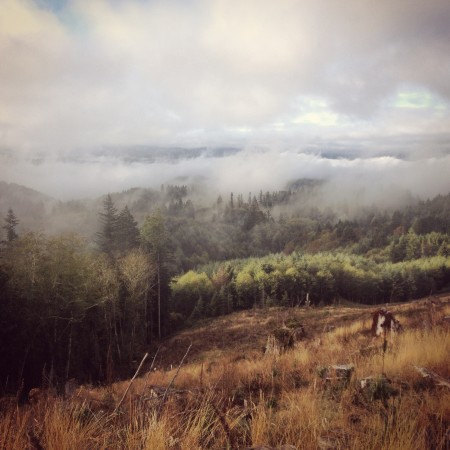
Mists of the Willapa. | ©2014 H a v e n

Mists of the Willapa. | ©2014 H a v e n

I am finding myself lost in this hunt, this search. I know as a kid growing up in Carson there were, and are, some places, that you just don’t share with anyone, unless they know the code. The code of belonging, and trust, pack it in, pack it out. This ritual always felt sacred to me and solidified my sense of belonging to the community. When asked by an ‘out-of-towner’ if I knew how to get to the hot springs, I would point them to St. Martins , not wanting to give away the magic of the natural Springs, that was for us! It is this kind of rights of passage I felt I may break through if I visited the ‘Stump’. I would then be a local.
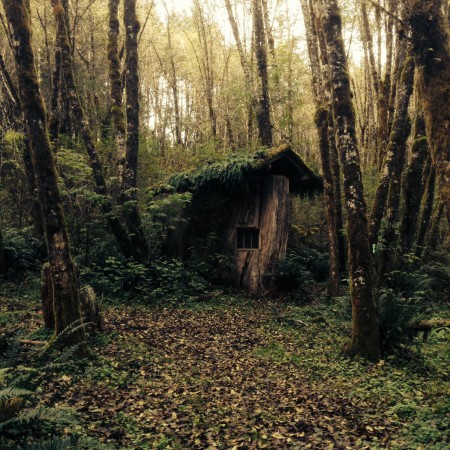
Stump Haus

Stump Haus

We came down the mountain from Elk camp to have the same Red Hawk fly with us at the same spot as before. I can not help but take notice when such events happen. As we passed by the old bridge again, my neck hairs raised ever so slightly. I wandered into town with tales from the hunting trip, but as soon as I told people where we set up camp, people told me, ‘the stump house is up that way..’ I knew it!
Mt. Shasta and JC Brown’s Lost City

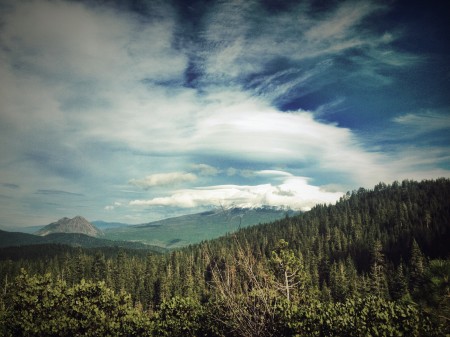
Mt. Shasta | ©2014 H a v e n

Mt. Shasta | ©2014 H a v e n

According to legend, JC Brown was a British prospector who discovered a lost underground city beneath Mt. Shasta in 1904. Brown had been hired by The Lord Cowdray Mining Company of England to prospect for gold, and discovered a cave which sloped downward for 11 miles. In the cave, he found an underground village filled with gold, shields, and mummies, some being up to 10 feet tall.

Thirty years later, he told his story to John C. Root who proceeded to gather an exploration team in Stockton, California. 80 people joined the team, but on the day the team was to set out, Brown did not show up. Brown was not heard from again.

Why there are no snakes on Takhoma | Cowlitz Legend

A long, long time ago, Tyhee Sahale became angry with the people. Sahale ordered a medicine man to take his bow and arrow and shoot into the cloud which hung low over Takhoma. The medicine man shot the arrow, and it stuck fast in the cloud. Then he shot another into the lower end of the first. He shot arrows until he had made a chain which reached from the cloud to the earth. The medicine man told his klootchman and his children to climb up the arrow trail. Then he told the good animals to climb up the arrow trail. Then the medicine man climbed up himself.

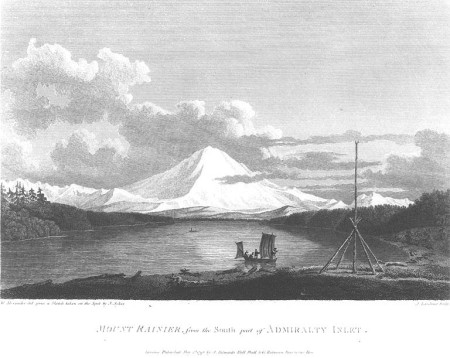
mt rainier admiralty inlet 1792

mt rainier admiralty inlet 1792

Just as he was climbing into the cloud, he looked back. A long line of bad animals and snakes were also climbing up the arrow trail. Therefore the medicine man broke the chain of arrows. Thus the snake and bad animals fell down on the mountain side. Then at once it began to rain. It rained until all the land was flooded. Water reached even to the snow line of Takhoma. When all the bad animals and snakes were drowned, it stopped raining.

After a while the waters sank again. Then the medicine man, and his klootchman, and the children climbed out of the cloud and came down the mountain side. The good animals also climbed out of the cloud, Thus there are now no snakes or bad animals on Takhoma.