“Call your spirit back. It may be caught in corners and creases of shame, judgment, and human abuse.
You must call in a way that your spirit will want to return.” – Joy Harjo
Introduction
Sometimes I think of this blog as a basket. A basket I’m always filling with fragments of myself. Land and water have their own ways of holding onto what matters, even as everything else shifts and slips away. Longing and belonging run through these pages; old stories keep surfacing, no matter how often we’re told to let them go or leave them behind.
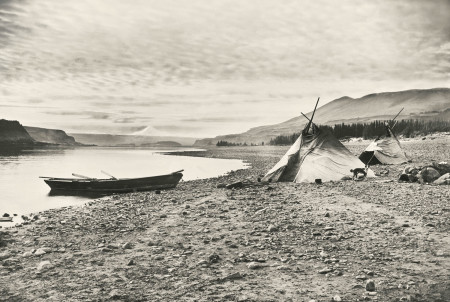
Home Guard on the Columbia, by Benjamin A Gifford (1899) (photo- courtesy The Valley Library, Oregon State University)
Writing all this has been my way of making sense of what’s been lost and what still survives. Of finding the places where grief and hope sit side by side. Some days, the words come easy, like Coyote slipping through the brush; other days, it’s just sitting with the ache, waiting for something true to rise up.
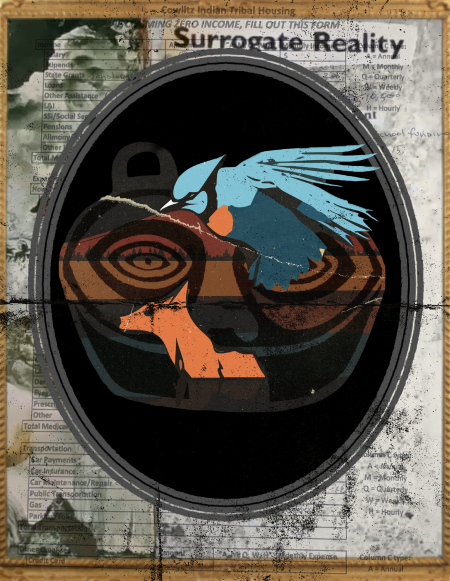
Art by Si Matta
If you find yourself anywhere in this tangle—wondering, remembering, searching for language that feels like home—just know you’re not alone. There’s room here for all of it: the old stories, the quiet resistance, the new ways we find to belong to ourselves and each other. This is just another piece of the gathering. Let’s see where it leads.
I.Where the Story Glitched
As the onslaught of settlers to the Columbia River Basin dredged a new paradigm of disease and displacement, there was what Hunn describes as a “spiritual apocalypse” among the River People. (Hunn & Selam, 1990, p. 241) A “spiritual apocalypse” where animist cultures struggled with the biological reality of disease, for there had to be a spiritual reason for the trauma- something must be out of alignment with the spirit.
There are stories older than the fractures we inherit. Before the missionaries, before the epidemics, before the thunder of Coyote’s mischief echoed up the river, there was a different kind of order—one in which Tsagaglalal kept her eyes on the people, and the world was alive with spirit. But when Coyote turned her to stone and declared an end to women’s leadership, something was set in motion. Later, when settlers swept through, bringing disease and displacement, the River People faced not just a physical apocalypse, but a spiritual one. My ancestors, like so many others, searched for meaning in the devastation, believing something must be out of alignment with the spirit. I feel that search still, running like an undercurrent beneath my own questions of belonging, faith, and truth. The fracture didn’t end with them. It runs through me, too, and through the stories I’m still learning how to tell.
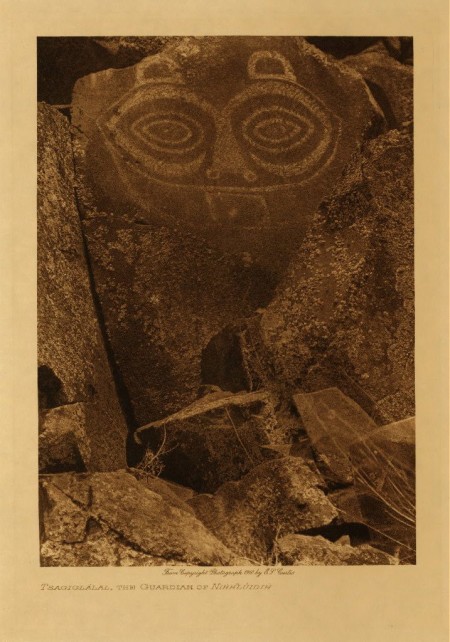 In my family, and in the memories that float up around shared meals or linger in the quiet after a prayer, I sense the echoes of this original break. There’s a hunger to explain why so much was lost, why the world my great-grandparents described feels so different from the one I grew up in. The old stories say that when Coyote came upriver, laughing and clever, he brought change that was meant to keep order, but instead left us with a wound that never quite healed. Tsagaglalal—She Who Watches—was given a stone body so she could see forever, but her voice became something we had to listen for in the wind, or in the pause before an elder speaks.
When settlers arrived, carrying new gods and new diseases, the ground shifted again. The River People, rooted in animist ways,where stones, salmon, and even the wind carried spirit, were suddenly forced to face loss on a scale that felt impossible. Hunn called it a “spiritual apocalypse,” a time when the breach between body and spirit became impossible to ignore. When whole villages disappeared overnight, when familiar ceremonies failed to keep death away, my ancestors,like so many others at the time, searched for answers in the only places they could: in dreams, in stories, in the uneasy sense that something was out of balance in the world.
It’s strange how trauma moves through generations. The original fracture—the turning of a matriarch to stone, the erasure of women and two spirit people from ceremony, was just the first. Every wave of missionaries, every epidemic, every law forbidding ceremony or language widened that split, until the silence itself felt inherited. I grew up catching glimpses of what was missing: a grandmother’s hesitation before telling an old story, a tightening around the word “queer,” the careful folding of hands before a meal, as if trying to keep the sacred from spilling out.
I wonder sometimes if this is why shame comes so easily—why depression feels built into the
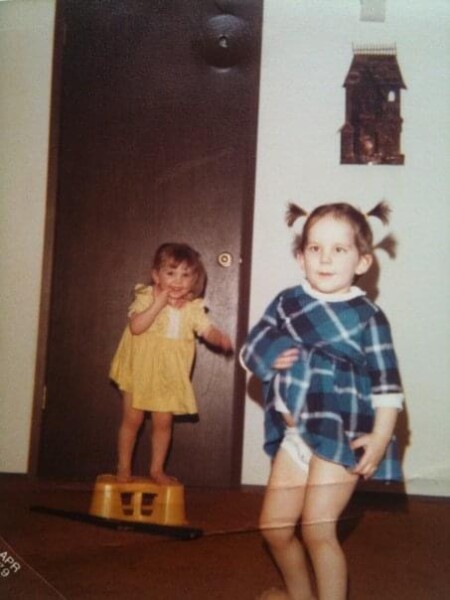
My Sister and I, circa 1979
bones, why addiction and silence become so familiar. Colonial violence didn’t just take land or language; it planted silence deep in our blood, teaching our ancestors to guard their words, to tuck away what was sacred or strange for fear of punishment or loss. When you’re told that spirit and body are separate, that who you are or who you love is out of alignment with what the world expects, the original wound gets handed down- wrapped in shame, caution and grief. That kind of silence settles in quietly, showing up in the hesitation before a question, in the way stories are stopped short, in the careful ways we move through spaces that never felt safe for all of who we are. It’s a fracture that isn’t just history. It’s lived and relived every day, quietly shaping how we see ourselves and what we’re allowed to speak aloud. In this haze, the birds whispered my name.
II. The Birds Whispered My Name
Some birds are not meant to be caged, that’s all.- Stephen King
The birds whispered my name,
As I fidgeted on a cold chair,
Learning of a god dressed in thorns.
As they talked in righteous dictation,
I would pull thorny brambles from dirty hands-
Finding god in the splinters.
I remember how the rain tasted-
Dry in safe beds made from synthetic fibers.
Yet I could hear the birds whisper my name,
Telling me stories,
We forgot to tell ourselves.
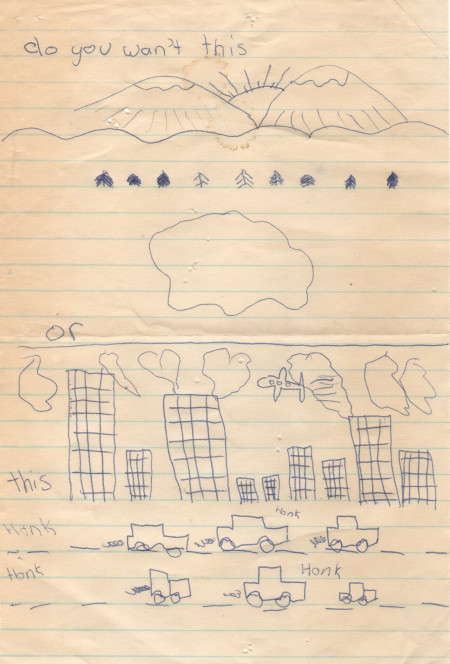
A very early drawing my sister, Jadie Russell, drew in church. 1980′s